
Denmark never withdrew recognition of Kosova, but Malagurski’s fake news did its job anyway
Boris Malagurski’s profile does not align with objective journalism, he is a propagandist who uses the international audience to shape perceptions of reality in the Balkans
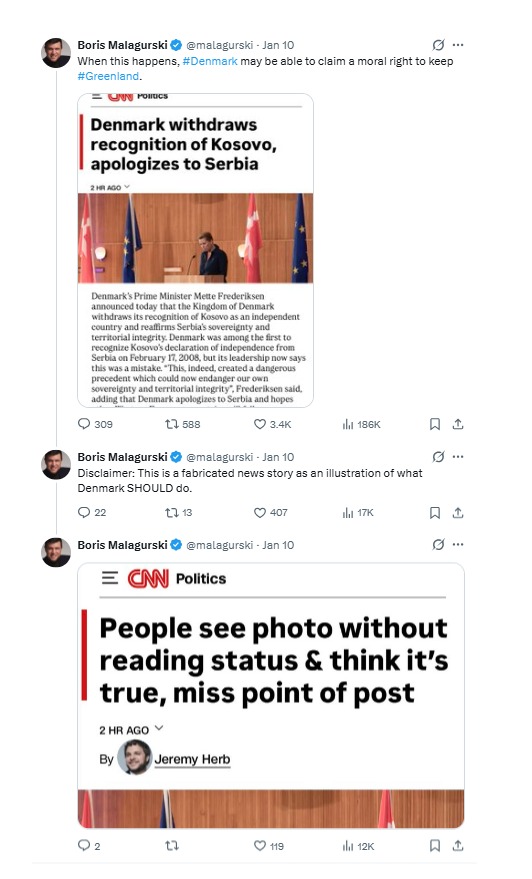
The case of Boris Malagurski and his post suggesting that Denmark had withdrawn recognition of Kosova’s independence illustrates more than just a minor social media falsehood. He published an image that appeared to be a news article from CNN Politics, claiming that Denmark had apologized to Serbia and revoked recognition of Kosova as an independent state.
The appearance of the “news article” was carefully designed to look professional and credible, using CNN’s logo and typical formatting, a well-known visual manipulation technique that gives false information an illusion of truth. The immediate effect is clear: most users see the image without reading the explanation, taking it as fact, which generate massive misinformation in the public sphere.
When reactions began to mount, Malagurski added a note stating that the story was fabricated and intended merely as an illustration of what Denmark “should” do. However, this is not a true correction. The initial spread of the falsehood had already generated discussion and misinformation, and the later disclaimer does not reverse that effect. This reflects a familiar propaganda pattern: misleading information is released, allowed to permeate the audience, and then defended or relativized, giving the author formal protection while the factual damage persists.
The case also highlights how Malagurski operates more broadly in the realm of disinformation concerning Kosova. He has a long history of downplaying Serbian crimes, presenting Kosova’s statehood as a “dangerous precedent,” and using pseudo-analytical language to justify Belgrade’s official narrative.
This profile does not align with objective journalism, he functions as a propagandist who uses the international audience to shape perceptions of reality in the Balkans. Furthermore, he has been declared persona non grata by Kosova authorities, a measure aimed at protecting the constitutional order and the country’s sovereignty and identifying his activities as harmful and destabilizing.
Beyond filmmaking and political commentary, Malagurski is active on social media and frequently produces posts designed to influence international opinion through sensational headlines. In many cases, this has caused widespread misinformation and debates about his role as a sophisticated propagandist.
From a media-analysis perspective, this incident exemplifies the use of “clickable content” as a tool for disinformation. Sensational headlines and visually designed news images create an immediate emotional response from readers. These readers often do not fact-check or verify sources, resulting in the viral spread of the falsehood. Later, when a clarifying note is added, the broad audience often misses or misunderstands it, leaving the impression that an event occurred when it did not. This is precisely the power of modern propaganda: it manipulates perception and shapes public opinion without needing to produce factual evidence.
In this context, Malagurski’s post is not just a single mistake. It is part of a broader strategy to disinform and undermine the legitimacy of the state of Kosova, using visual tools and narrative framing to sow doubt and divide international opinion. His combination of visual falsehoods and relativizing disclaimers represents a sophisticated form of audience manipulation, placing him squarely among active propagandists targeting Kosova. /The Balkan Report/
Discover more from The Balkan Report
Subscribe to get the latest posts sent to your email.