Vidovdan, the Battle of Kosova and the Third Rome: The mythical trinity of Serbian nationalism
Historians agree that the battle ended in a strategic victory for the Ottoman Empire
In the modern history of the Balkans, historical narratives have become weapons. Nowhere is this more evident than in Serbia, where three mythical pillars: the ideology of the Third Rome, Vidovdan, and the Battle of Kosova, form the core of Serbian nationalist identity and fuel a political and religious ideology that has legitimized aggression, expansionism, and the denial of historical and political realities in the region.
These are not merely relics of the past but living narratives that convey a sense of messianic mission, perpetual victimhood, and claims of moral and spiritual superiority over neighboring peoples. They have influenced the political developments of the 20th century and continue to shape Serbian attitudes toward Kosova and the West, producing tangible political, diplomatic, and military consequences.
The concept of the Third Rome first emerged in 15th-century Russia, following the fall of Constantinople, now Istanbul, to Sultan Mehmed II. With the collapse of ancient Rome and the Byzantine Empire, Moscow declared itself the heir of Orthodox Christianity. Serbia positioned itself as a spiritual ally in this mission through the Orthodox Church and myths tied to the empire of Tsar Dušan.
Under the current leadership of President Vladimir Putin, this doctrine has been revived as a tool of Russian foreign policy. In this context, Serbia has become a transmitter of this conservative and anti-Western vision, where alliance with the Kremlin is portrayed as a civilizational union against a “decadent” West and an Islamized Balkans.
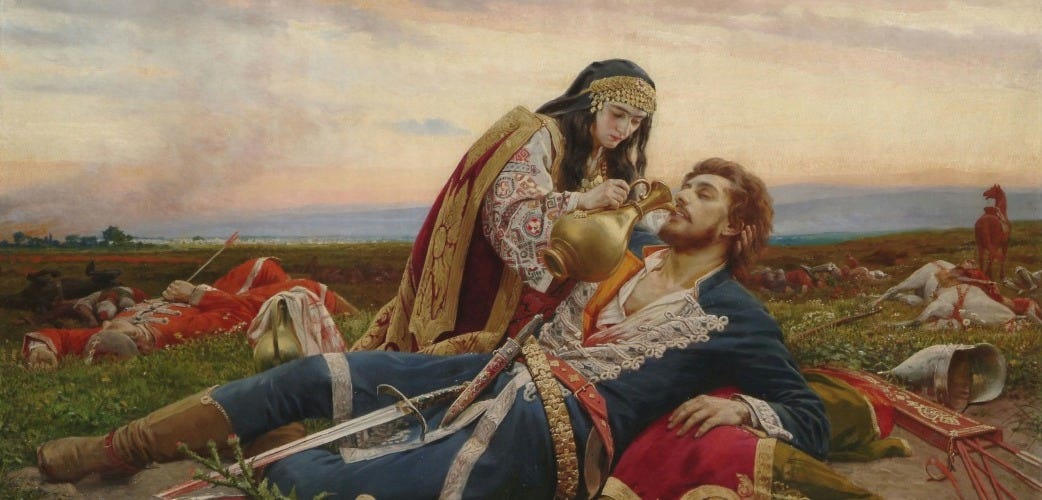
Vidovdan, observed on June 28 in the Orthodox calendar, is one of the most symbolically charged dates for Serbian nationalist identity. It is closely linked to the Battle of Kosova in 1389, a confrontation between the forces of Serbian Prince Lazar Hrebeljanović and the Ottoman army led by Sultan Murad I. Although the historical reality of the battle is different, in the Serbian collective consciousness it has been transformed into a tragic myth, in which Serbs are credited with a moral victory despite having lost the battle.
Historians agree that the battle ended in a strategic victory for the Ottoman Empire. After Prince Lazar’s death and the weakening of the Serbian state, his territories were incorporated into the Ottoman structures. However, Serbian mythology portrayed this event as a divine sacrifice, where Lazar chose the “heavenly kingdom” over an “earthly victory,” glorifying loss and martyrdom.
On June 28, 1914, Gavrilo Princip, a member of the “Black Hand” organization, assassinated the Austro-Hungarian heir to the throne, Franz Ferdinand, in Sarajevo, an act that triggered World War I. The choice of date was not accidental. The terrorist act was not just a political assassination, but a powerful symbolic statement intended to reignite nationalist feelings and provoke fundamental changes in the geopolitical order of the time.
Similarly, on the 600th anniversary of the battle, Slobodan Milošević delivered a dark speech at Gazimestan on June 28, 1989, heralding a new era of nationalism. In that infamous speech, he declared: “Today, six centuries later, we are again in battles. And these are not armed battles, although such things are not yet excluded.” It was a warning of war, a signal for redrawing borders and igniting ethnic conflicts.
The speech of the Butcher of the Balkans intertwined the Vidovdan myth with political reality, portraying Serbia as a victim surrounded by enemies, including ethnic Albanians in Kosova, Bosniaks, Croats, and the West. This narrative served to justify ethnic cleansing, repression, and wars that left behind thousands of victims.
This myth did not form immediately after the battle but was gradually constructed through folklore, epic songs, and politics. During the 19th century, in the era of the Serbian National Revival, it became the foundation of a nationalist project for territorial expansion, especially toward Kosova.
Folklore was instrumentalized to strengthen Serbian identity and tie the myth to territorial claims. Prince Lazar was canonized as a martyr, Miloš Obilić was elevated as the symbol of supreme heroism, while Vuk Branković was depicted as the archetype of betrayal that supposedly caused the loss. These figures were institutionalized by the Orthodox Church, intellectual elites, and Serbian folklorists, constructing a national identity based on victimhood, lost heroism, and hatred toward “the others.”
The Orthodox Church has preserved and disseminated these myths as the most powerful cultural and political institution in Serbia. Through liturgies and control over collective memory, it has helped build a national identity that glorifies defeat and vilifies neighbors. Even today, it remains a strategic ally of conservative and anti-Western policies.
This mythical trinity has served as a tool for legitimizing aggression, denying Kosova’s statehood, and fueling the wars of the 1990s. Myths are not innocent; in the hands of leaders like Milošević, they became war banners and justifications for crimes against humanity.
Kosova is not the “heart of Serbia,” nor is Serbia the Third Rome, but an independent and democratic state that has chosen a clear Euro-Atlantic path. Serbia is not a “fortress of Orthodoxy” but a country gripped by myths that must come to terms with historical reality.
In an era when disinformation and mythological narratives are used as geopolitical weapons, the region needs a deep deconstruction of nationalist myths and a clear separation between history and propaganda. Only then can the Balkans build lasting peace, and a future based not on sacred losses, but on historical truths. /The Balkan Report/
Discover more from The Balkan Report
Subscribe to get the latest posts sent to your email.