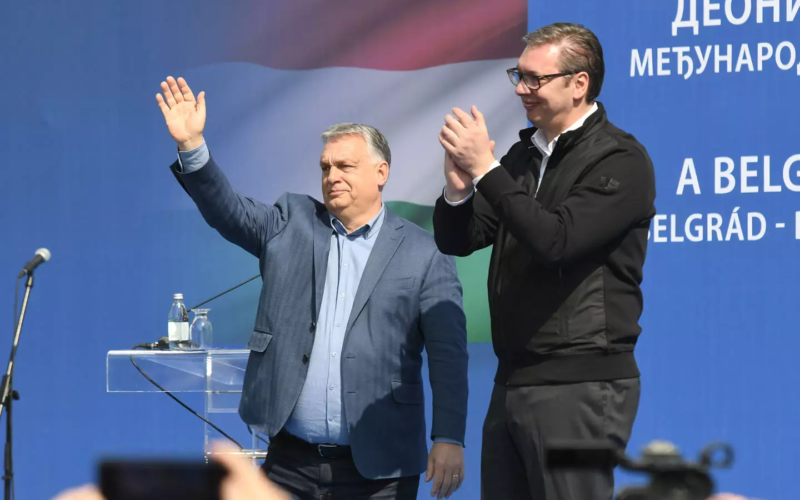
The victory of Péter Magyar over Viktor Orbán is not merely a change of power within a country but the collapse of a regime that, for years, was built on control of information, the capture of institutions, and the manipulation of public perception. This development has already sent shockwaves across the Balkans, particularly in Serbia.
What makes this moment critical is not just the fact that a powerful leader was defeated, but how it happened. Orbán controlled the vast majority of the media, had built an extensive economic and political network dependent on his rule, and had institutionalized a form of hybrid democracy in which elections were held but the playing field was deeply unequal. These are precisely the core elements of Aleksandar Vučić’s model.
In Serbia, media control constitutes structural domination. National television channels serve as instruments of propaganda, where the government is portrayed as the sole guarantor of stability, while the opposition is systematically stigmatized. Space for criticism is limited and is often accompanied by economic or political pressure on journalists and media owners. This creates a parallel reality in which public perception is carefully managed.
One of the strongest and most troubling pillars of Vučić’s power is his near-total control over the security and intelligence apparatus, particularly through the Security Information Agency. In Serbia, this institution has effectively been turned into a direct instrument of power. It is used for the systematic surveillance of political opponents, the gathering of compromising information, the intimidation of critical voices, and the protection of structures that serve the regime.
An important role in maintaining control is also played by the Orthodox Church, which has consistently acted as an ideological and political pillar supporting the regime. Through its deep influence in society, it contributes to shaping and reinforcing nationalist narratives, legitimizes government decisions, and often serves as a bridge between the state and more conservative segments of society. In many cases, its discourse aligns with that of the government, creating a symbiotic relationship in which politics and religion intertwine to preserve the status quo.
Allegations of ties between the political elite and criminal groups are no longer merely opposition rhetoric but part of public discourse supported by investigations and media reporting. This creates a power structure in which loyalty is based not only on ideology or political interest but also on economic and criminal ties.
In this context, Vučić’s reaction to developments in Hungary has been tense. He has rejected any parallel between Hungary and Serbia, yet this very rejection reveals the sensitivity of the moment. What happened in Hungary is not an isolated case but a precedent that could inspire similar dynamics in other countries with comparable systems.
One of the most interesting aspects of this development is the direct message Magyar has sent to Serbian citizens. He has called on them to draw strength and inspiration from Hungary’s elections, emphasizing that change is possible. This message is not merely symbolic but a call for mobilization and a direct challenge to the narrative of such regimes, which seek to create the impression that their power is permanent.
This call lands on already turbulent ground. In recent months, Serbia has faced a wave of student and civic protests reflecting deep dissatisfaction with the country’s political and social conditions. Students have taken to the streets, demanding more freedom, greater transparency, and an end to a system they perceive as unjust and closed. These protests are neither spontaneous nor isolated but part of a broader trend of civil resistance.
The regime’s response to these protests has been harsh and, in many cases, repressive. There have been reports of pressure on organizers, police intervention, and attempts to discredit protesters through pro-government media. This clearly demonstrates that the government perceives this movement as a genuine threat rather than a passing episode.
At this point, the parallel with Hungary becomes even stronger. There, too, for years, the opposition and civil society appeared powerless against a consolidated system. What changed was a combination of factors: a new figure challenging the system from within, broad civic mobilization, and a political moment that enabled change.
In Serbia, these factors are beginning to emerge, even if they have not yet consolidated into a clear political alternative. Still, the existence of a precedent such as Magyar’s alters the calculations of all political and social actors. It shows citizens that even the strongest regimes can fall, and it signals to elites within the system that their loyalty is not guaranteed indefinitely.
Another key element is the international dimension. For years, Vučić has pursued a balancing policy between the West and Vladimir Putin, using this position to consolidate his internal power. However, this balancing act has its limits. In an increasingly polarized geopolitical context, the space for maneuver is shrinking.
At the same time, it is clear that Vučić is not interested in a final agreement with Kosovo. On the contrary, the current status quo serves him politically, as it allows him to maintain a nationalist narrative and use the Kosovo issue as a tool for internal mobilization. A final settlement would require compromise, something that could weaken his domestic political position.
This makes the situation even more complex for the region. While Hungary appears to be moving toward a more democratic and open model, Serbia risks further authoritarian consolidation in response to internal and external pressure. This creates ongoing tension with potential consequences for the stability of the entire Balkans.
However, political history shows that such moments also present opportunities. When a system begins to crack, it often collapses faster than expected. Magyar’s victory is a clear example of this dynamic. It was not merely the result of a successful campaign but the accumulation of factors that, at a certain point, produced change.
In this sense, Serbia is at a point where all these factors are beginning to converge: public dissatisfaction, international pressure, fractures within the system, and now a regional precedent demonstrating that change is possible. This does not mean that change is inevitable, but it does suggest that it is more likely than ever.
What remains to be seen is whether these elements will coalesce into a unified force capable of genuinely challenging Vučić’s power. If that happens, then what began in Budapest may continue in Belgrade. And if that occurs, the Balkans could enter a new political phase in which authoritarian models are no longer the norm but the exception.
In the end, Magyar’s message to Serbian citizens is simple but powerful: change does not occur on its own, but it becomes possible when people believe they can achieve it. After what happened in Hungary, that belief is no longer an illusion, it is a reality that is only beginning to take shape. /The Balkan Report/
Discover more from The Balkan Report
Subscribe to get the latest posts sent to your email.