Media freedom in Kosova: Rise in ranking, stagnation in structure
Political influence remains one of the most serious challenges for media in Kosova
The state of the media in Kosova in 2026 presents a clear contrast between improvements in international indicators and deep structural problems that continue to shape how the media actually functions on the ground.
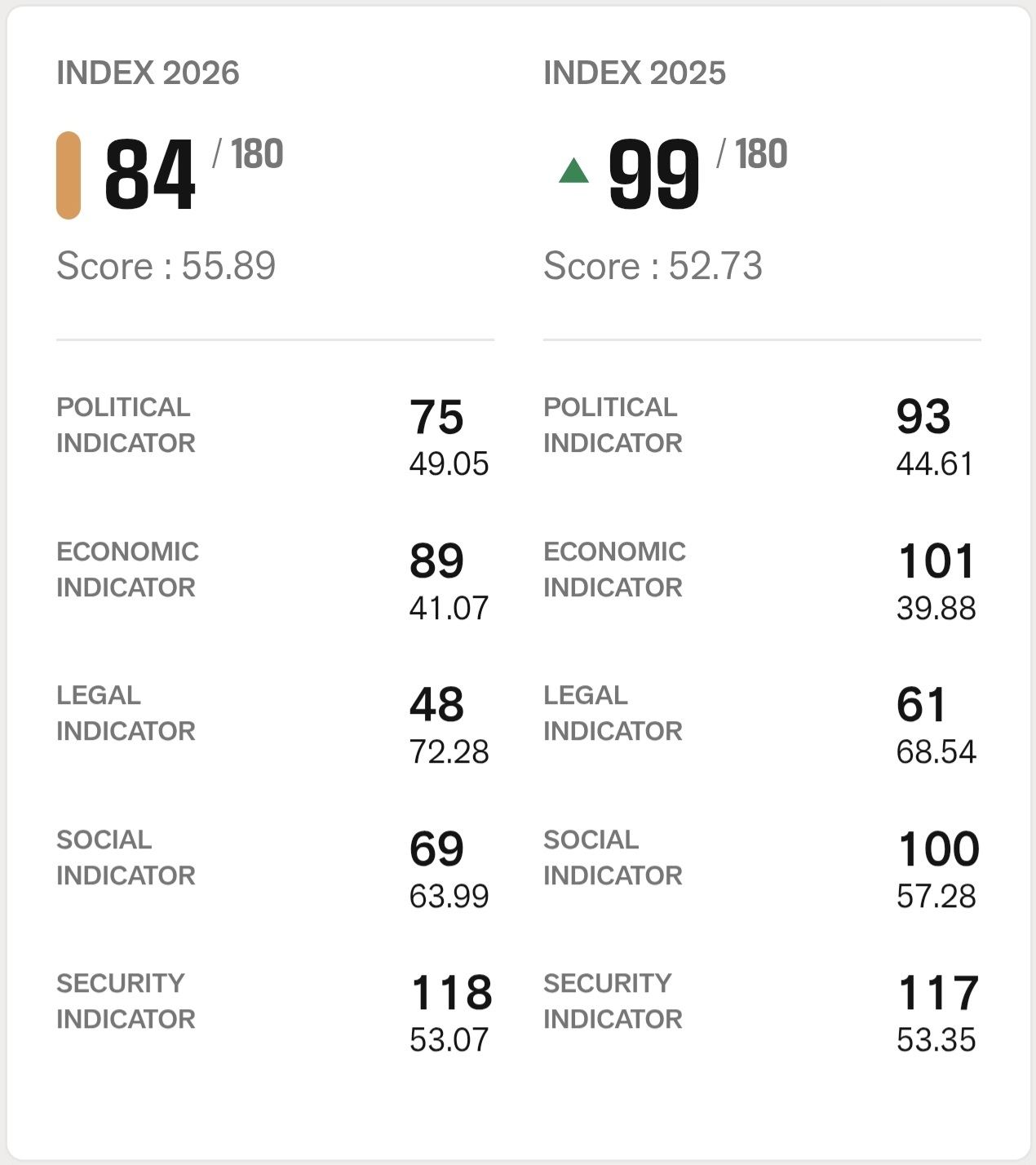
According to Reporters Without Borders, Kosova is ranked 84th out of 180 countries in the World Press Freedom Index, marking a significant rise of 15 positions compared to the previous year. This improvement is a positive signal at the international level, but it should not be read superficially as evidence of a profound transformation of the country’s media system.
At its core, this upward movement reflects more a relative stabilisation and some measurable improvements in specific indicators than a fundamental shift in the relationship between media, politics, and the economy. The fact that Kosova still remains among the “lower-ranked” European countries in terms of press freedom, despite this progress, clearly indicates that the challenges are structural and long-term.
In a regional comparison, Kosova’s position places it in an uncertain middle ground. Albania ranks slightly higher at 83rd, Bosnia and Herzegovina at 90th, while Serbia remains lower at 104th. On the other hand, Montenegro and North Macedonia perform significantly better, ranked 41st and 45th respectively, while Croatia stands at 53rd. This positioning shows that Kosova is neither among the worst performers in the region nor close to countries that have managed to consolidate a stable and resilient media freedom environment. Instead, it occupies a grey zone where a functional level of pluralism exists, but not a consolidated standard of media independence.
One of the most visible features of Kosova’s media market is its formal diversity. There is a relatively large number of media outlets, including television stations, online portals, and radio broadcasters operating within a small market. This pluralism is often presented as a positive indicator, as it allows for a wide range of voices to be heard. However, this diversity is constrained by the size of the market, which makes financial sustainability difficult in practice.
This creates a paradox: many media outlets but limited stability. Under such conditions, survival often depends on external sources of funding, which are rarely neutral. Media in Kosova is primarily financed through advertising revenues from the private sector, a source that in a small economy is limited and often concentrated in the hands of a small number of economically powerful companies. This concentration creates a complex relationship between media and advertisers, where financial dependency can easily translate into editorial influence.
In addition, media outlets are sometimes supported by municipal authorities or political actors, which further blurs the boundary between public information and political interest. This hybrid funding model, combining private revenue with partial and often non-transparent institutional support, creates an environment in which editorial autonomy is constantly under pressure.
A further critical dimension is the ownership structure of media organisations. In many cases, media owners have broader business interests or political connections, which directly expose newsrooms to interference. These interventions are not always visible or direct, they often manifest through self-censorship, editorial orientation, or the selection of topics that are covered or avoided. In this way, the influence of powerful political and economic groups becomes structural rather than episodic.
This creates a reality in which media independence is not only challenged by the state, but also by the market. Instead of functioning as a guarantor of pluralism and competition, the market often operates as a mechanism of pressure due to its limited size and the concentration of financial resources.
Political influence remains one of the most serious challenges for media in Kosova. Although journalists and media outlets frequently succeed in holding those in power accountable, they continue to face persistent pressure, both in the form of direct attacks and indirect mechanisms of influence. Boycotts of selected media, attempts to influence public broadcasters, and interference in regulatory bodies are all part of this environment. The contested reform of the Independent Media Commission, later declared unconstitutional, is a clear example of tension between political power and institutional independence.
This tension is not isolated, but part of a broader pattern in which political actors attempt to shape public narratives. In consolidated democracies, media functions as a counterbalance to power. In Kosova, this counterbalance exists but is weakened by economic dependency and the lack of strong institutional safeguards capable of protecting it.
The legal framework in Kosova is relatively advanced compared to many countries in the region. Freedom of expression is guaranteed, defamation has been decriminalised, and there is a legal basis for source protection and access to public information. However, the main issue lies in implementation. Laws are often not enforced effectively, creating a gap between formal standards and practical reality.
One of the most persistent problems is access to public information. Although journalists have a legal right to request and receive information from public institutions, in practice this is frequently obstructed by bureaucracy, lack of transparency, or unjustified refusals. This significantly limits the ability of journalists to conduct in-depth reporting and hold institutions accountable.
A growing concern is the rise of Strategic Lawsuits Against Public Participation (SLAPPs). These lawsuits are used by powerful actors to intimidate and financially exhaust journalists and media organisations. Even when such cases do not result in convictions, the legal process itself serves as a form of pressure. This produces a chilling effect, encouraging self-censorship as journalists seek to avoid costly legal battles.
At the societal level, the situation is equally contradictory. On one hand, journalists enjoy a relatively high level of public trust. On the other hand, they are frequently targeted on social media and in public discourse. Accusations such as “collaboration with the enemy” or similar labels create a polarised environment in which critical journalism is perceived as a threat rather than a public service.
This phenomenon is closely linked to broader political and social dynamics in the country and the region. Political tensions, internal polarisation, and external influences are directly reflected in how media and journalists are treated. In this context, media often becomes a battleground for competing narratives rather than a neutral instrument of information.
Journalist safety remains a sensitive issue. Although there have been no killings of journalists since 2005, threats, physical attacks, and other forms of pressure are still present. Furthermore, the lack of accountability for past crimes, including killings and disappearances during and after the war, continues to affect perceptions of safety and the overall media environment.
Against this backdrop, Kosova’s improvement in this year’s index should be seen as an opportunity, but not as a completed achievement. It signals that progress is possible and that some positive developments may have occurred, but it does not change the fact that core challenges remain unresolved. Compared to countries such as Montenegro or North Macedonia, which have developed more stable media environments, Kosova still has significant ground to cover. At the same time, its better position compared to Serbia and its proximity to Bosnia and Herzegovina and Albania show that it is not an extreme outlier in the region, but rather a system in transition.
Ultimately, what becomes clear is that media freedom in Kosova is not primarily a question of the number of media outlets, but of the quality of conditions under which they operate. The improvement in ranking is an important indicator, but it is not sufficient to guarantee a free, independent, and sustainable media system. The real challenge lies in building a framework where media is not dependent on political or economic pressure, where laws are effectively enforced, and where journalists can operate without fear of intimidation, threats, or indirect censorship.
This is the difference between a media system that exists, and a media system that functions. /The Balkan Report/
Discover more from The Balkan Report | Truth Matters.
Subscribe to get the latest posts sent to your email.