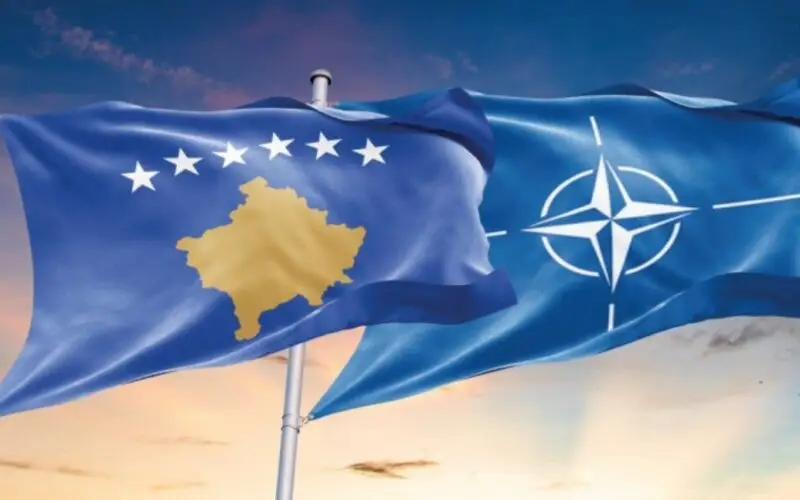
The initiative to introduce a resolution in the U.S. Congress in support of Kosova’s integration into the North Atlantic Alliance should be viewed as a development of particular strategic weight at a time when Europe’s security architecture is undergoing profound transformation. This initiative is not merely an isolated political act but a reflection of a new geopolitical reality in which regions like the Western Balkans are returning to focus as arenas where great power interests collide and where the absence of a complete security structure creates real risks to stability.
Since declaring independence in 2008, Kosova has built a clear identity as a state with an unwavering Euro-Atlantic orientation. With over 120 international recognitions and a strong partnership with the United States and most NATO countries, it has demonstrated that it is a responsible actor contributing to regional stability. However, the lack of NATO membership continues to leave Kosova in a strategically uncertain zone, where risks are not merely theoretical but also concrete and persistent.
The primary risk stems from Serbia, which continues to refuse to recognize Kosova’s statehood and pursues a dual-track policy, maintaining close ties with Russia while formally aiming at European integration. This dual positioning is not neutral; it creates space for Russian influence in the region and for the use of hybrid tools of destabilization. Violent incidents in recent years in the north of Kosova, led by terrorist Milan Radoičić, including attacks against international forces and local institutions, clearly indicate that tensions can escalate at any moment.
In this context, the idea that stability can be maintained without a strong security guarantee is becoming increasingly untenable. Experience from the past decades in the Balkans has shown that without a clear and credible defense structure, any political and institutional achievement remains fragile. For this reason, Kosova’s membership in NATO should be considered a strategic necessity rather than a long-term objective that can be postponed.
One of the strongest arguments in favor of membership is the development of the Kosova Security Force. Its transformation from a civilian-mandated force into a modern military force has progressed significantly in recent years. With direct support from international partners, the KSF has increased its capacities in training, equipment, and interoperability with NATO standards. Participation in joint exercises and gradual integration into modern military doctrines have transformed it into a force that is no longer in an embryonic phase but rather in a phase of consolidation.
An important development reinforcing this trend is the trilateral military agreement between Kosova, Albania, and Croatia. This agreement aims to strengthen the defense capabilities of the three countries, enhance cooperation in the defense industry, and improve military interoperability through education, training, and joint exercises. For Kosova, this represents an important opportunity to accelerate its military transformation and deepen integration with NATO standards through cooperation with two alliance member states.
However, these developments, as positive as they are, cannot replace NATO membership. They are important steps toward preparedness but not a final solution to the security question. In the absence of the collective defense that NATO provides, Kosova remains exposed to various pressures, including hybrid threats, political interference, and potentially more serious security incidents.
This is why the resolution proposed by U.S. congressmen carries particular importance. It does not address only matters of U.S. foreign policy but a broader issue of European security. By calling on Greece, Romania, Slovakia, and Spain to reconsider their positions on Kosova, the resolution seeks to unblock a process that has been stalled for political reasons but carries direct strategic consequences.
At a time when Europe is facing major security challenges, including Russian aggression and tensions along its eastern borders, the Balkans cannot remain a gray zone. Any security vacuum in this region is an opportunity for external actors to intervene and destabilize it. Kosova’s integration into NATO would eliminate one of these gaps and significantly strengthen the security architecture in Southeastern Europe.
Moreover, Kosova’s NATO membership would have a direct deterrent effect on any actor that might consider destabilizing actions. The principle of collective defense, which lies at the heart of NATO, would ensure that any threat against Kosova would be met with a coordinated response from all member states. This fundamentally changes strategic calculations and significantly reduces the risk of conflict.
Ultimately, Kosova’s NATO membership is not only a matter of its own future but also of the stability of the entire region. Without this step, the Balkans will continue to be a fragile zone, exposed to tensions and external interference. With it, a new reality is created, where security and stability are grounded in a sustainable and credible structure.
Therefore, Kosova’s integration into NATO should be treated as an urgent strategic priority. It is not only in Kosova’s interest but also in the interest of NATO itself and the broader Euro-Atlantic community. In a world where insecurity is growing and the international order is being challenged, such decisions are essential to ensuring long-term peace and stability. /The Balkan Report/
Discover more from The Balkan Report
Subscribe to get the latest posts sent to your email.