Authorities in Serbia appear unwilling to trust U.S. Customs authorities. Due to allegations of forced labor, the United States has imposed restrictions on imports of copper, and earlier on vehicle tires, from two Chinese companies operating in Serbia: Zijin Copper and Linglong.
While U.S. authorities have raised concerns about unpaid wages, confiscation of workers’ personal documents, restrictions on freedom of movement, and excessive overtime work, the relevant Serbian institutions have remained silent. Meanwhile, President Aleksandar Vučić has expressed greater concern over the export bans.
Zijin Copper stated that it takes the allegations made by U.S. authorities seriously and is currently reviewing them. The company emphasized that it opposes all forms of forced labor.
The U.S. Customs and Border Protection Agency announced that it had issued a withholding order on copper and copper products produced by Zijin Copper Serbia. Several months earlier, the same measure had been imposed on vehicle tires manufactured by Linglong.
The non-governmental organization China Labor Watch has also reported documenting cases of forced labor in the Chinese companies Zijin Copper and Linglong in Serbia. Both companies are among Serbia’s largest exporters.
Zijin Copper was established in 2018 after acquiring control of the Bor Mining and Smelting Basin (RTB Bor) in eastern Serbia. Its parent company, Zijin Mining, owns 63 percent of the shares, while the Serbian state holds 37 percent. Linglong, meanwhile, has been operating in Zrenjanin, northeastern Serbia, since September 2024, when its factory was inaugurated after five years of construction.
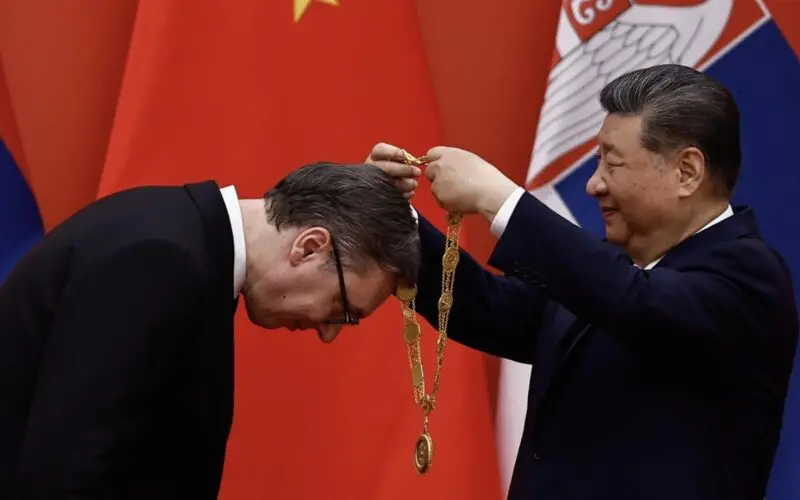
The Serbian government declared the 800 million euro project a strategic investment of national importance, presenting it as evidence of the partnership between Belgrade and Beijing. As part of strengthening what Serbian and Chinese leaders describe as their “steel friendship,” Serbian authorities have announced plans for increased Chinese investment.
Regardless of the U.S. measures, Serbia should have launched an investigation into the forced labor allegations through coordinated action by the labor inspectorate, the prosecution service, and the Center for the Protection of Victims of Human Trafficking.
Serbia has ratified the key international instruments related to human trafficking and forced labor. These include conventions of the International Labour Organization (ILO), United Nations instruments through the Palermo Protocol, and the Council of Europe Convention on Action Against Trafficking in Human Beings.
Following the publication of the findings from the U.S. customs investigation into Zijin Copper, President Vučić stated that the Serbian state would assist the company as much as possible in resolving its export-related problems.
“It is clear that, in this geopolitical conflict where everyone is against everyone else, but where two major powers stand out, the United States and China, we are paying the price,” Vučić said earlier this week.
He also stated that he believes Serbia, through dialogue with the Americans, “will be able to help, at least to some extent, the company in Bor, which employs 7,000 people and keeps eastern Serbia alive.”
Several months earlier, Vučić described the U.S. decision to ban imports of vehicle tires from Linglong as “shameful.”
“This is frightening. Someone in the U.S. administration has adopted a completely false story that Chinese workers there are being subjected to forced labor,” Vučić told TV Pink.
On the same day he announced that the state would assist Zijin Copper regarding the U.S. export ban, the Serbian president visited an exhibition at the Chinese Cultural Center in Belgrade dedicated to the friendship between Serbia and China.
During the visit, he argued that sanctions against China and protectionist measures targeting it could not succeed.
At an event marking the 10th anniversary of the establishment of the strategic partnership between Serbia and China, Vučić stated that China “will continue to grow and develop, and will gradually overcome these obstacles one by one, ultimately emerging even stronger and more successful.” /RFE/
Discover more from The Balkan Report
Subscribe to get the latest posts sent to your email.