The recent operation by the Special Structure Against Corruption and Organized Crime (SPAK) in Albania represents one of the most significant blows against organized crime in the Balkans in recent years. The scale of the investigation, the amount of cocaine documented by the authorities, the number of assets seized, and their estimated value of around 150 million euro indicate that today’s criminal structures operating in the region are no longer local or national organizations. Instead, they are part of global networks linking Latin America with Europe, generating billions of euros annually through drug trafficking, money laundering, and other illicit activities.
According to data published by SPAK, the group under investigation is suspected of trafficking at least 50 tons of cocaine between 2019-2021, while in five documented incidents, law enforcement authorities in Belgium, the Netherlands, Ecuador, and Colombia seized nearly 9 tons of cocaine. These quantities alone translate into hundreds of millions of euros in potential profits on the European drug market.
However, the importance of this operation goes beyond the volume of drugs seized or the number of arrests. What makes the case particularly significant is that the investigation has focused on tracing criminal capital and the way profits from drug trafficking are transformed into legitimate assets. For years, European security agencies have warned that the greatest threat from organized crime is not only drug trafficking itself, but the ability of criminal organizations to penetrate economies, invest illicit profits into strategic sectors, and build political and institutional influence.
According to SPAK’s investigation, a significant portion of the profits generated from international cocaine trafficking were transferred to Albania in cash and subsequently invested in construction companies, hospitality businesses, real estate, business shares, and tourism projects. The list of seized assets includes hundreds of properties, hotels, villas, apartments, commercial companies, and bank accounts located in some of the country’s most developed areas. Only in the Lalzi Bay area, more than 120 residential and tourist units were seized, while other properties are located in Tirana, Durrës, Himara, Saranda, and other cities.
This case confirms a phenomenon long highlighted in reports by Europol, Eurojust, and other international organizations monitoring organized crime. The Western Balkans has become one of the most advanced hubs for international drug trafficking toward European Union markets. The region’s geographic position, transport infrastructure, and institutional weaknesses inherited from the post-communist transition have created conditions that allow criminal organizations to build stable operational networks.
Unlike the 1990s, when the main criminal activities in the region were linked to fuel, cigarette, and arms smuggling, today criminal organizations are fully integrated into global narcotics markets. Decrypted communications from Sky ECC, EncroChat, and ANOM have revealed that many Balkan criminal organizations have established direct contacts with drug cartels in Colombia, Brazil, Peru, and Ecuador. In many cases, these groups no longer act as intermediaries. They have become direct components of the global supply chain, organizing the purchase, transport, storage, and distribution of cocaine across European markets and beyond.
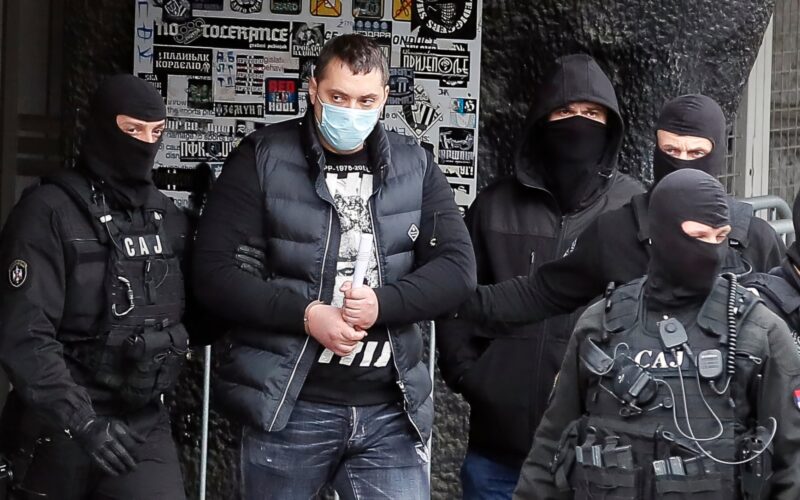
In this context, Serbia has drawn particular attention from European security authorities in recent years. A significant number of international investigations have identified the presence of Serbia-based criminal structures involved in international cocaine trafficking, money laundering, arms smuggling, and other transnational criminal activities. Europol-led operations, supported by decrypted communications from Sky ECC and EncroChat, have revealed the important role of some of these networks in organizing multi-ton cocaine shipments from Latin America to Europe.
Arrests carried out within international operations have shown that a significant portion of key figures in Balkan cocaine trafficking had established direct contacts with producers and traffickers in Latin America. Investigations have also revealed that these organizations controlled the logistics of drug shipments to ports such as Rotterdam and Antwerp, long considered the main entry points for cocaine into the European market.
One of the most concerning aspects of these investigations relates to persistent suspicions of overlap between organized crime and certain segments of political, economic, and security structures in Serbia. The case of Veljko Belivuk’s group, considered one of the most violent criminal organizations in the region, raised serious questions about the level of criminal infiltration into state institutions. Publications based on Sky ECC communications and investigative reporting across the region have further fueled concerns about links between criminal figures and parts of the state apparatus. Reports from international investigations have also addressed cases involving cocaine trafficking networks, the use of diplomatic channels, contacts with political figures, and the influence of individuals close to power in facilitating criminal activities. Although many of these claims remain under judicial and investigative review, they have contributed to serious concerns among European partners regarding the extent of organized crime’s influence in Serbia.
However, the phenomenon is not limited to Serbia. The Western Balkans as a whole has become a space where criminal organizations operate beyond ethnic and political boundaries. In practice, criminal groups in the region frequently cooperate in drug trafficking, money laundering, and smuggling. For these organizations, financial gain is far more important than the political rivalries that continue to characterize the region.
In Kosova, security institutions have intensified operations in recent years against smuggling, money laundering, drug trafficking, and cross-border criminal networks. Particularly in the north of the country, authorities have carried out a series of actions revealing links between criminal activity, organized structures, and political influences that have operated for years in this area. Investigative reporting and security institution findings have shown that the north of Kosova has long served as a favorable space for various criminal activities, including smuggling, tax evasion, drug trafficking, and money laundering. In recent years, the Kosova Police have uncovered several cannabis cultivation laboratories in the north, linked to individuals and structures that have exerted political and economic influence in the area.
These developments have reinforced assessments by local and international institutions that organized crime in the region is not limited to drug trafficking or traditional smuggling, but is often intertwined with networks of economic, political, and security influence. In this context, the name of Milan Radoičić has been repeatedly mentioned in international reports, US and UK sanctions decisions, and media investigations related to alleged criminal activities, smuggling, and influence over local power structures.
The Banjska events in September 2023 further increased international attention on northern Kosova. The terrorist attack on the Kosova Police, in which Sergeant Afrim Bunjaku was killed, demonstrated that in some cases there is a concerning overlap between criminal structures, armed groups, and political agendas aimed at destabilizing security and constitutional order. For many security experts, smuggling networks, drug trafficking routes, and groups involved in violent activities should not be seen as separate phenomena, but as part of the same criminal infrastructure that benefits from institutional gaps and political tensions in the region.
For this reason, operations conducted by the Kosova Police and the Special Prosecution between 2024-2026 have been important not only in criminal terms, but also in strengthening the rule of law and extending state authority across the entire territory. Kosova’s experience shows that the fight against organized crime cannot be limited to arrests or seizure of contraband. It also requires dismantling the full financial, logistical, and political infrastructure that enables these networks to function.
Recent operations across the region have revealed a new reality of organized crime in the Balkans. These are no longer small groups engaged only in drug trafficking or smuggling, but sophisticated structures operating simultaneously in multiple countries, managing millions of euros in circulation, and using legitimate economic investments to conceal illicit origins of capital. Their financial power has allowed them to extend influence beyond the criminal sphere, penetrating strategic sectors and, in some cases, exerting pressure or influence over institutional processes.
One of the key lessons from the SPAK operation is that the fight against organized crime is entering a new phase. In the past, the focus was on arrests and drug seizures. Today, attention has shifted to financial investigations, tracing capital flows, and asset confiscation. International experience has shown that criminal organizations can replace arrested members relatively easily, but find it far more difficult to recover seized capital, assets, and financial infrastructure that sustain their operations. For this reason, the seizure of hundreds of properties in the recent operation is considered a strategic blow to criminal networks. If the charges are proven in court, the case could serve as a model for similar investigations across the region, focusing not only on drugs or direct perpetrators, but on how illicit profits penetrate economies, shape markets, and create hidden structures of power.
The recent SPAK operation goes far beyond a conventional cocaine trafficking case. It exposes how organized crime in the Balkans has evolved from smuggling networks into powerful transnational structures moving billions of euros, building economic empires, penetrating strategic sectors, and seeking influence beyond the criminal world. Whenever money generated from trafficking, smuggling, or other illegal activities enters the economy, finances businesses, buys property, corrupts officials, or influences public decision-making, crime acquires a new and more dangerous dimension. For the Western Balkans, the central challenge is no longer identifying criminal networks, but dismantling the financial infrastructure that sustains them. It is precisely in this confrontation between the rule of law and criminal capital that the future of security, democracy, and institutional stability in the region will be determined. /The Balkan Report/
Discover more from The Balkan Report
Subscribe to get the latest posts sent to your email.