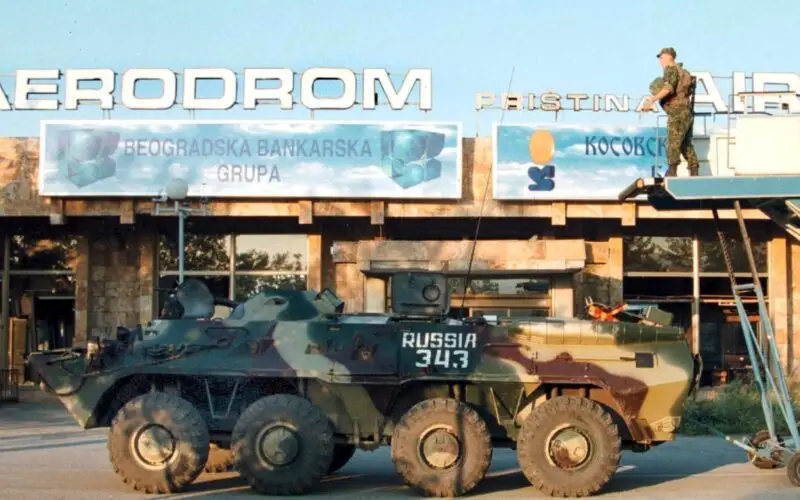
On 12 June 1999, while the citizens of Kosova were waiting with hope and emotion for the arrival of North Atlantic Treaty Organization forces following the end of the war and the withdrawal of Serbian military and paramilitary forces, a Russian military convoy departed from Bosnia and Herzegovina toward Kosova in a surprise operation that would trigger serious tensions between Moscow and the West. In the early hours of the morning, before the main KFOR units had deployed throughout Kosova, Russian troops managed to take control of Prishtina Airport, carrying out a coordinated operation in secrecy and without NATO Command approval.
For many international analysts, this was not merely a military maneuver but the first demonstration of Russia’s ambition to preserve its influence in the Balkans after the end of the Cold War. Although the Kremlin failed to secure a separate military sector in Kosova, as it had initially sought, the covert entry of its forces became a symbol of a policy that would continue for decades: opposition to the Western role in Kosova and unwavering support for Serbia’s strategic interests.
Today, twenty-seven years after that event, the list of Russian actions, interventions, and efforts directed against Kosova is extensive and encompasses military, diplomatic, propaganda, and security dimensions. In many instances, Moscow has appeared not only as Belgrade’s strongest ally but also as an active actor in efforts to obstruct the international consolidation of state.
Even before the end of the war, there were numerous reports of Russian nationals participating in Kosova on the side of Serbian forces. During the Battle of Koshare, the Kosova Liberation Army (KLA) claimed to have killed Russian officers and secured documents proving the presence of Russian mercenaries on the front lines. These reports reinforced the belief that Russian support for the regime of Slobodan Milošević extended beyond political and diplomatic backing and had taken more concrete forms on the ground.
When NATO intervened to stop the ethnic cleansing and crimes committed by Serbian forces against Kosova’s Albanian population, Russia positioned itself firmly against the Alliance’s military operation. Moscow viewed the intervention as a violation of the international order and has continuously used Kosova as an argument in its disputes with the West ever since. In fact, many scholars of international relations regard the Kosova crisis as one of the events that marked the beginning of a renewed strategic confrontation between Russia and Western countries in the post-Cold War era.
Following the end of the war, Russia launched a long-term diplomatic offensive against every initiative that could bring Kosova closer to full international recognition. During the years when Kosova’s final status was being discussed, Moscow became the principal obstacle to international efforts aimed at formalizing the solution proposed by United Nations Special Envoy Martti Ahtisaari. Using its position in the United Nations Security Council, Russia repeatedly warned that it would veto any resolution paving the way for Kosova’s independence.
In practice, this meant that the Kremlin was providing Belgrade with a powerful instrument to block international processes related to Kosova. For more than two decades, Russian diplomacy has appeared in virtually every international forum as the strongest voice opposing Kosova’s statehood. From the United Nations and its Mission in Kosova (UNMIK) to other international organizations, Russia has supported Serbian campaigns against recognition and Kosova’s membership in international institutions.
Meanwhile, the presence of the Russian contingent in Kosova between 1999 and 2003 was accompanied by a series of incidents that generated tensions with the local population and former KLA soldiers. One of the most well-known cases involved the detention of a vehicle carrying Ramush Haradinaj and Ahmet Isufi, which resulted in a physical confrontation between the parties. Russian soldiers were also involved in other incidents that further damaged their image among Kosova’s public.
The withdrawal of Russian forces in 2003 did not mark the end of Moscow’s involvement in the Kosova issue. On the contrary, it signaled the beginning of a new phase in which diplomacy, propaganda, disinformation, and influence operations would become the primary instruments of Russian policy in the region.
Only a few months after the departure of the Russian contingent, Kosova faced its most serious security challenge of the post-war period. The riots of 17 and 18 March 2004 resulted in deaths, hundreds of injuries, and extensive material damage. Although the events were triggered by reports that two Albanian children from the village of Çabër had drowned in the Ibër River after allegedly being chased by local Serbs, security experts have assessed that structures linked to Serbian and Russian interests exploited the crisis to promote destabilization and damage Kosova’s international image.
For years, Russia used the events of March 2004 as evidence to portray Kosova as unstable and incapable of guaranteeing the security of non-Albanian communities. For many analysts, the way Moscow instrumentalized the crisis represents one of the earliest examples of influence operations and propaganda being used to hinder Kosova’s progress toward independence and international consolidation.
When Kosova declared independence on 17 February 2008, Russia reacted harshly. For the Kremlin, Kosova’s independence represented not only the loss of a diplomatic battle in the Balkans but also a precedent that could be invoked in other geopolitical conflicts. For this reason, Moscow launched a broad international campaign to delegitimize the new state.
One of the most debated episodes of this period concerns support for initiatives that led to allegations of organ trafficking and the report by Dick Marty. Although these processes followed their own institutional paths within European bodies, many analysts have argued that Russian diplomacy played an active role in promoting narratives aimed at discrediting Kosova’s liberation struggle and its leading political figures.
In the years that followed, Russia continued to strongly support Serbia in every diplomatic battle against Kosova. When Kosova applied for membership in INTERPOL, Moscow openly opposed the bid and lobbied in support of Serbian positions. The same approach has been pursued in other international organizations, where Russia has used its diplomatic weight to limit Kosova’s international advancement.
One of the most symbolic episodes demonstrating Russian influence in the region occurred in January 2017 with the so-called “Russian train.” Decorated with Serbian nationalist inscriptions and slogans denying Kosova’s statehood, the train was dispatched toward the Kosova border in an action widely perceived as a political provocation. Kosova authorities prevented its entry, and the incident generated considerable tensions between Prishtina and Belgrade.
Parallel to its diplomatic activities, Russia has continuously invested in information warfare. Through state-controlled media, propaganda platforms, and influence networks across the Balkans, Moscow has promoted narratives designed to portray NATO’s intervention as illegitimate, to relativize the crimes of the Serbian regime, and to undermine the legitimacy of the state.
A clear example of this strategy was the release of the movie “The Balkan Line”, a cinematic production glorifying the entry of Russian forces into Prishtina Airport in 1999. The film presents the Russian version of events, portraying Russian soldiers as saviors while distorting the historical context of the Kosova war. Critics argue that this was not merely an artistic project but part of a broader propaganda strategy aimed at influencing public opinion in the Balkans and beyond.
Concerns about Russian activities have not been limited to propaganda. In recent years, Kosova institutions have repeatedly raised alarms about Russian intelligence operations in the region. The case of Mikhail Krasnoshchekov, a Russian UNMIK official arrested during a police operation in northern Kosova in 2019 for obstructing police activities and endangering public order and security, became one of the most discussed incidents in relations between Prishtina and Moscow.
Subsequently, Kosova declared several other Russian officials persona non-grata, arguing that their activities were incompatible with the country’s national security interests. These cases strengthened the conviction within Kosova’s institutions that Russia continues to view Kosova as an important arena for influence operations in the Balkans.
Russia’s invasion of Ukraine in 2022 brought Kosova back into the centre of Kremlin rhetoric. Russian President Vladimir Putin has repeatedly invoked the Kosova case to justify Russia’s actions in Ukraine, arguing that the West created a precedent by supporting Kosova’s independence. However, the majority of Western countries and experts in international law have rejected this comparison, arguing that Kosova’s case resulted from specific circumstances involving ethnic cleansing, war crimes, and international administration following the conflict.
In Kosova, recent developments in Ukraine have increased concerns that the strategic partnership between the Kremlin and Belgrade could be used to destabilize the Western Balkans. The terrorist attack in Banjska in September 2023, ongoing tensions in northern Kosova, and the activities of radical Serbian groups have reinforced the perception that Russian influence remains a relevant factor in regional security calculations.
Twenty-seven years after the entry of Russian forces into Prishtina Airport, the event continues to be viewed not as an isolated historical episode but as the starting point of a long-term Russian strategy toward Kosova. From support for the Milošević regime during the war to opposition to independence, diplomatic obstruction, propaganda operations, and influence activities across the region, Russia has remained one of the most consistent opponents of the consolidation of Kosova’s statehood.
June 12 remains the Day of Liberation, the day when NATO entered Kosova to bring an end to one of the darkest chapters in the country’s modern history. Yet the same date also serves as a reminder of another reality: Russia’s effort to preserve its influence in the Balkans and challenge the post-war order. Twenty-seven years later, the political and geopolitical consequences of that June morning in 1999 continue to be felt in Kosova and throughout the Western Balkans. /The Balkan Report/
Discover more from The Balkan Report
Subscribe to get the latest posts sent to your email.