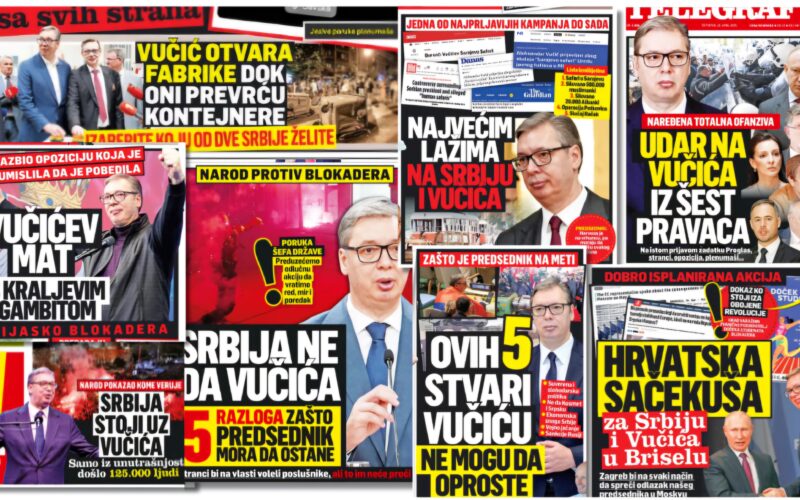
While students in Serbia were blocking university faculties and citizens were taking to the streets, Serbian tabloids knew exactly what their role was: to portray protesting citizens and students as terrorists and a security threat.
Informer, Alo, Srpski Telegraf, Večernje Novosti, Kurir and Politika together published more than 1,800 manipulative articles on their front pages alone in 2025, according to Raskrikavanje’s analysis. One of the key topics on their front pages was precisely the student protests, blockades and citizens’ gatherings. At the top of this inglorious ranking was once again Alo, with 529 manipulative articles, followed by Informer with 399, Srpski Telegraf with 294, Politika with 253, Večernje Novosti with 197 and Kurir with 191.
The object of adoration was, predictably, Serbia’s president Aleksandar Vučić. He appeared on front pages more than a thousand times, and not a single one of those articles portrayed him in a negative light. He was depicted positively in 88% of cases, while in Kurir that figure reached a perfect 100%.
Manipulation of facts and bias were by far the most common techniques used by pro-regime tabloids, while Večernje Novosti appears to be almost specialised in propaganda, which accounted for half of its manipulative content. Nearly half of all manipulative articles were published without the author’s name. Kurir holds the record in this category as well, with more than 90% of such articles unsigned. When the author is unknown, the source is no longer reliable. In Srpski Telegraf, every fourth manipulative article relied on anonymous sources.
Most often, these were students, the opposition, Croatia, Albin Kurti or foreign intelligence services. Opposite them, almost as a rule, stood President Vučić, presented as the last line of defense against chaos, violence and the destruction of the state.
An analysis of front pages shows that Alo published at least 529 false, unfounded or manipulative stories during the year, making it the tabloid with the highest amount of such content in a single year.
This was also due to the fact that politics overwhelmingly dominated its content. As many as 80% of articles concerned domestic politics, while an additional roughly 15% were devoted to foreign policy. Alo wrote about these topics largely in an overtly biased and unjournalistic style. The views of students, professors, opposition figures or other actors being written about were generally absent or manipulated, while representatives of the authorities and people close to them dominated among the sources.
The topic of the year was the student protests that began after the collapse of the canopy in Novi Sad. The tabloid’s editorial policy towards them was entirely uniform. Students were very rarely presented as citizens who were protesting. Instead, this tabloid usually profiled them as a security and political threat and as enemies of the state. On the front pages they were called “blockaders,” “hooligans,” “fascists,” “terrorists,” “layabouts,” and participants in a “colour revolution.” The protests were described as attempts to spark civil war, a coup d’état or a violent seizure of power, while in relation to the students the tabloid almost routinely searched for who was behind them, listing the opposition, foreign intelligence services, non-governmental organisations, Croatia, Albania, Kosova or Western states.
Headlines such as “Blockaders ready to kill,” “Terrorists planned bloodshed on Vidovdan,” “Blockaders want civil war,” “Opposition plans a Maidan in Belgrade,” and “The blockader dossier: Beat, burn, destroy and spit on Serbia,” were just some examples of the rhetoric that dominated throughout the year. At the same time, Alo insisted on the message that the protests lacked broader public support and represented the actions of a small group of people endangering “decent Serbia.” On the other hand, the tabloid exaggerated the number of participants at counter-protests organised by the Serbian Progressive Party (SNS), while treating the messages from those gatherings as far more sincere and relevant than those from the student protests.
Vučić was almost constantly present on Alo’s front pages. His photograph appeared as many as 202 times during the year, more often than every other day. Unlike his political opponents, who were most often portrayed as a threat to the state, Vučić was without exception presented in a positive light. In more than 90 percent of cases, headlines accompanying his photograph were affirmative, while not a single negative narrative about him was recorded.
The same logic applied to international politics. Russia, Viktor Orbán, Vladimir Putin and the authorities of Republika Srpska were almost without exception portrayed positively. On the other hand, Croatia, Kosova, Albin Kurti, NATO, the European Union and Western states were often presented as enemies of Serbia or sponsors of the protests, whose services allegedly closely cooperated in organising the blockades. Many individuals were also labelled as ringleaders or as people secretly leading the broader civic and student rebellion.
The owner of the tabloid Alo is the little-known businessman Saša Blagojević. At the very end of 2025, he founded a new company, Best Media Team, and just six days later two television stations from Užice came under its control. In the period that followed, the network of media outlets connected to Blagojević expanded to Čačak, Priboj, Valjevo, Bačka Palanka, Zrenjanin, Loznica, Kikinda and Ivanjica. His portfolio also includes the Belgrade city television station Studio B. Through public procurement and project-based media co-financing, Alo’s publisher received more than 143,000 euro in 2025.
If someone had learned about Serbia in 2025 exclusively through the front pages of Informer, they would have gained the impression that the country was living in an almost permanent state of emergency. Hardly a student action, protest or blockade passed without the tabloid warning of bloodshed, a coup d’état, civil war, terrorism or an attempt to overthrow the state. A total of 399 false, unfounded or manipulative stories were recorded on this tabloid’s front pages. Like other tabloids, Informer claimed that the opposition “wanted” Vučić killed. Thus, at the very beginning of 2025, it claimed that Miloš Jovanović, leader of the New DSS, had called for the murder of the Serbian president and for “throwing Vučić off a balcony.” It turned out that Jovanović had said no such thing. Instead, the pro-regime X account “Detektor Laži” manipulated his statement to make it appear as though he was advocating violence and calling for the murder of President Vučić.
In addition to the opposition, which it accused of “wanting power by force,” whose representatives it called “haters longing for bloodshed,” and “mad with hatred towards Vučić,” Informer also saw former U.S. President Joe Biden among those allegedly organising Vučić’s overthrow. After Donald Trump’s administration suspended USAID funding, the tabloid claimed that Biden had allocated more than 900 million dollars through this American agency to bring down Vučić. The tabloid arrived at that figure by adding together the funds USAID had given over the previous four years for projects in Kosova and Bosnia and Herzegovina.
The past year in Serbia was marked by mass protests and university blockades. In line with the position of the Serbian authorities on these protests, Informer reported on them extremely negatively, often running smear campaigns. It referred to protesting citizens by the derogatory term “blockaders,” and accused them of “wanting a lynching,” of being “terrorists,” of “destroying Serbia,” and of ruining faculties and Serbia’s economy. Often, the only source for such claims was the tabloid’s editor-in-chief, Dragan J. Vučićević. For example, in late May, Vučićević claimed that the “blockaders had formed paramilitary units” whose goal was “bloodshed at faculties.” He made these claims on the basis of a document in which not only was no such thing mentioned, but it was not even confirmed that the document had been produced by students.
Vučić appeared 185 times on the front pages of this tabloid. The president was mostly portrayed positively or in the role of a victim. “A statesmanlike move by the president. Vučić extends a hand,” “No one is stronger than the state. War has begun! Vučić launches total crackdown on corruption,” “Vučić brings all world leaders together in Serbia,” “The West undermines Vučić and Fico,” “The president sounds the end of the blockades. Vučić: Serbia has won,” were some of the headlines in last year’s editions of Informer.
Informers were also prone throughout the past year to manipulating the number of people attending protests. While it declared citizens’ protests to be “failures,” often downplaying the number of those present and claiming that blockaders were committing violence, abusing and terrorising citizens, it wrote in glowing terms about SNS rallies. It described those rallies as “magnificent,” and often estimated attendance figures higher than the number of people who could realistically physically fit into those spaces.
Behind Informer stands Vučićević, who controls 99% of ownership through the company Insajder Tim, while the remaining one percent belongs to longtime director Damir Dragić. In 2025, this company received almost 192,000 euro through public procurement and project-based media co-financing. The business paths of Informer and Alo crossed at the beginning of 2026. Shortly after Alo owner Saša Blagojević founded the company Best Media Team, Insajder Tim became its co-owner by purchasing a 10% stake. That share was paid for with just 10,000 dinars.
Several days before the large student protest on 15 March, the public was flooded with a secretly recorded audio recording of a meeting between activists from the STAV group and the Movement of Free Citizens. The authorities claimed that the recording constituted proof that a coup d’état was being prepared. Soon after, six activists were arrested, while another six people from the recording remain abroad to this day. Srpski Telegraf devoted significant attention to this case on its front pages. “Scenario for a coup d’état,” and “Recording reveals hellish plans for today’s rally. They prepared a military coup and street war” were among the headlines the paper published in those days.
One of the arrested activists, then a member of the STAV group, Lazar Dinić, spent seven months in detention. The tabloids’ writing about him and his colleagues was a true reflection of the agenda of pro-regime newspapers: to always maintain the appearance that the state is under attack. He says that during walks while under house arrest, passers-by shouted insults at him two or three times because they believed what they had read in the tabloids. He forwards all publications he considers false or manipulative to his lawyer, although he says he no longer even knows how many proceedings have been launched so far. What happened after his release from detention was particularly striking to him. While the arrests had been the leading topic in numerous media outlets for days, news of his release passed almost unnoticed.
Biased articles and spins about Dinić and his colleagues were not an isolated case in Srpski Telegraf. The analysis shows that this tabloid published 294 manipulative, unfounded or biased stories last year. The central figure in Srpski Telegraf last year was, as has become tradition, President Vučić. His image appeared on the front pages of this tabloid as many as 254 times. He was mostly presented in a positive context: as a hero, builder, fighter for Serbia’s interests, a man of his word, a saviour and someone without whom Serbia simply could not survive.
“The vast majority of the people are with Vučić,” “Vučić opens factories while they overturn bins,” “He crushed the opposition (…) Vučić’s checkmate with the king’s gambit,” “Five reasons why Vučić must stay,” “Vučić the visionary” are just some examples of how this tabloid portrayed the president in 2025. In addition to this heroic role, he was often assigned the roles of victim and defender of Serbia. “President under attack,” “Attack on Vučić from six directions,” “Croatian ambush for Serbia and Vučić,” “They are after Vučić’s head,” “Hunt for Vučić’s head,” and “They are bringing Vučić down because of the success of the defence industry,” were just some of the headlines in Srpski Telegraf.
And while the paper reported on the president mostly positively, it had no kind words for the student protests and blockades that marked the previous year.
It claimed that “political terror and violence” were being carried out against the people, that the goal was “the murder of Vučić,” that the “protests destroyed Serbia’s economy,” and that the “blockaders are savages.”
The spreading of panic and threats of violence at protests was particularly noticeable ahead of several mass protests held during 2025. For example, ahead of the student protest held in Belgrade on 15 March, Srpski Telegraf spent days announcing violence and chaos, and relayed Vučić’s warnings that protesting citizens would seize the National Assembly, the Constitutional Court and RTS; that Serbia would “be left in darkness,” and that a “coup d’état” had been planned. The tabloid continued its one-sided reporting in the days after protest. It was at that protest, during the tribute to those killed in Novi Sad, that a loud, unknown sound rang out in Kralja Milana Street, causing a stampede among the gathered citizens. Earshot, an international non-profit organisation that analyses sound, determined that four recordings from the site of the “sound impact” contained a noise produced by a Vortex Ring Gun or Vortex Cannon. In line with the position of the state leadership, however, Srpski Telegraf continued to claim that this was an “invention” and that a “factory of lies activated the sound cannon.”
Srpski Telegraf additionally backed these claims with reports from Russia’s FSB, which “determined” that no sound cannon had been used at the 15 March protest. Several times during the year, the tabloid claimed that a color revolution was being carried out in Serbia, a term that otherwise refers to non-violent protests directed against authoritarian regimes. In this story, the “foreign factor” was an indispensable actor: the paper claimed that “blockaders are pumping things up with Germans and Croats” and that there was “crystal-clear evidence of collusion in carrying out a color revolution.”
The basis for these claims was a petition launched by the Serbian diaspora in June, asking the Bundestag to send diplomats to observe protests and trials in Serbia. The petition arose in response to increasing violence against protesters and the arrests of political activists. For Srpski Telegraf, citizens seeking international observers because of police repression were sufficient proof that someone from outside was organising the overthrow of the state.
In 2025, Politika published at least 253 manipulative texts on its front pages, and the dominant techniques it used were propaganda and bias. This newspaper, more than 120 years old, is today owned by Smederevo businessman Boban Rajić, who also owns Večernje Novosti. Judging by its front pages alone, it is now hard to justify its reputation as a serious daily newspaper. Unlike Informer or Alo, for example, Politika does not feature sensationalist headlines and photographs that “scream” from the front page. Very often, instead of open propaganda, the paper operates through subtle narratives, with a neutral headline, only for the article to reveal itself as, for example, a transmission of Vučić’s statements without a single critical question or any voice from the other side.
Articles based exclusively on the president’s television appearances and statements regularly ended up on the front page, while Vučić’s photograph appeared there as many as 188 times, always positively or neutrally, never negatively. A special place in Politika was occupied by the column of SNS MP Vladimir Đukanović, which often crossed into open attacks on students and critics of the authorities. In one of them, he claimed that Vučić’s critics “control everything in the country” and that the authorities must “clean them out to the last one.”
Precisely because it does not act sensationally and does not label critics of the authorities with insults, as Informer does, for example, manipulative stories in Politika are harder to recognise. The paper still enjoys a certain prestige because of its long tradition, and that makes it more dangerous than it appears at first glance. The analyses year after year show that, through its complete absence of any criticism of the authorities, Politika consistently places itself among pro-regime media.
Večernje Novosti has existed for more than 70 years and is also owned by Smederevo businessman Boban Rajić. For years, another constant has been added to its traditional conservative framework: unconditional support for SNS and Vučić. That was also the case in 2025. Last year, this media published at least 197 manipulative articles, mostly concerning domestic politics.
Vučić appeared on the front pages of Večernje Novosti 160 times last year, and none of those articles had a negative tone. The headlines and articles almost without exception boiled down to relaying the president’s statements, without additional context or critical distance. His messages did not remain merely one item of information in daily reporting, but became the basic framework for interpreting political events and social crises. This approach was also visible in the choice of sources. The articles were dominated by representatives of the authorities, state officials and analysts whose views are acceptable to the current regime.
The same applies to reporting on protests and student blockades. These were written about exclusively through a negative prism. Protest participants were not citizens expressing political or social dissatisfaction, but a factor of instability, an obstacle to economic development or a potential security threat. According to these articles, protests caused chaos, violence and threats to the state.
Večernje Novosti was particularly “talented” at explaining every social or political crisis through external influence rather than authentic public dissatisfaction. Instead, foreign centres of power, intelligence services, foundations or Serbia’s regional opponents were regularly found behind them. Thus, according to Novosti headlines, Croatia and its services were “cooking up” blockades in Serbia; the British were preparing the ground for a “government of experts;” USAID had for years been working on “hollowing out Serbia from within;” while Proglas and the opposition were allegedly taking over the student protests for their own political goals.
For regular readers of Novosti, Serbia is a country under constant pressure from external and internal enemies, while the authorities and the president are positioned as the last line of defense of the state. In this way, every topic and every potential problem for the authorities is treated in the same manner and becomes part of the same broader narrative about an endangered Serbia that is constantly defending itself against different centres of power. As many as 157 of the 197 manipulative articles were unsigned. NID Novosti, the company that publishes Večernje Novosti, signed contracts in 2025 with a total value of more than 286,000 euro.
A year before Telekom Srbija officially acquired a majority stake in Kurir in the Serbian Business Registers Agency, its owner Igor Žeželj had already signed a purchase agreement with this state-owned company. Coincidence or not, 2025 was a record year in terms of the number of manipulations on its front pages, the analysis showed. The newspaper published as many as 191 manipulative headlines, almost exclusively related to political topics, while Vučić appeared on its front pages as many as 236 times, always in a positive light. This kind of reporting by Kurir has represented a consistent editorial policy for years, namely since the paper was taken over by Igor Žeželj.
The increase in manipulations on Kurir’s front pages was probably a reflection of a year marked by student protests. Thus, the authorities were always the victims of organised attacks, while critics were coordinated opponents of the state. There was almost no phase of the student blockades or citizens’ gatherings that was not presented as manipulation, deception or someone else’s project. Students were at times “tricked”; at other times they allegedly did not know what their demands were; at still other times they had supposedly been taken over by the opposition and Proglas. The front pages particularly insisted that all demands had already been fulfilled, so every continuation of the protests was presented as proof of hidden political intentions: “What more: all demands fulfilled,” “The fourth demand fulfilled too, but the blockades remain,” “Politicisation of the protest,” and “A fight for power and more money down to the last student and schoolchild”.
Kurir, too, consistently followed a narrative that perfectly suited the authorities: that the protests were part of a broader plan to overthrow Vučić, that is, a color revolution. Thus, on its front pages, the protests were linked to foreign intelligence services, the opposition, Croatian influence, international regime-change networks and various political groups. Serious political events were often given short labels as well: “horrific,” “secret plan,” “exposed,” “confusion,” “vandalism,” “attacker,” and “destruction of the state.”
In addition to students, the opposition and professors, one of the most frequent targets of the negative campaign on Kurir’s front pages was Dragan Šolak, minority owner of several media outlets in Serbia. Throughout the year, a series of headlines repeatedly portrayed him as the central organiser of political and media attacks: “Attacker on minister works at Šolak’s Shopster company,” “N1 and Nova S extort British fund on behalf of Šolak,” “How Dragan Šolak cut deals behind the backs of majority owners,” and “Šolak spent years robbing business partners.”
These articles are particularly significant in view of the ownership and business conflicts between Telekom Srbija and the minority owner of United Group. Mondo, Kurir’s publisher, signed contracts worth around 130,000 euro last year through public procurement and project-based co-financing.
Discover more from The Balkan Report
Subscribe to get the latest posts sent to your email.