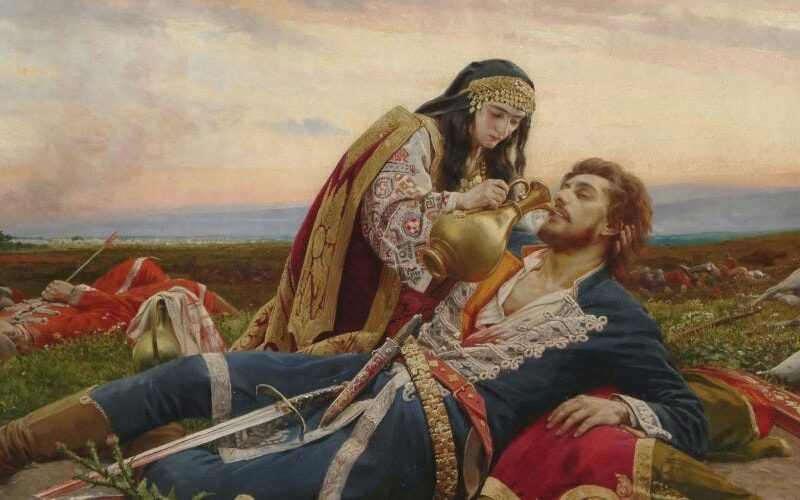
History is not merely a narrative about the past, it can serve as a source of identity, memory, and reflection. However, in the hands of political and religious elites, it can also be transformed into an instrument of power, mobilization, and legitimization of conflict. In the Balkans, few historical narratives have had as profound a political impact as the myth of the Battle of Kosova and the symbolism of Vidovdan. For more than two centuries, these narratives have been turned into pillars of Serbian nationalist identity, nurturing a political culture built on sacrifice, victimhood, and the claim of a historical and religious mission.
In fact, Vidovdan cannot be understood as an isolated symbol; it is part of a broader ideological architecture built on three main pillars: the doctrine of the “Third Rome,” the Kosova myth, and the cult of Vidovdan. These narratives, intertwined with the role of the Serbian Orthodox Church, nineteenth-century romantic nationalism, and the state policy of modern Serbia, created an identity that portrays the Serbian nation as a chosen people, a perpetual victim, and a defender of Orthodoxy in the Balkans. At various historical moments, these myths were used to justify territorial claims, hegemonic policies, and, by the late twentieth century, military aggression against neighboring peoples.
These are not merely folkloric stories or elements of cultural heritage. They continue to influence Serbia’s political discourse, its relations with Kosova, Bosnia and Herzegovina, Montenegro, and the West, producing concrete consequences in regional politics even today.
To understand the political significance of Vidovdan, one must first examine the ideological context in which it developed. One concept that strongly influenced the formation of Slavic Orthodox nationalism was the doctrine of the “Third Rome.” This idea emerged in Russia after the fall of Constantinople in 1453. With the collapse of the capital of the Byzantine Empire and the end of a state that for more than a thousand years had been regarded as the center of Eastern Christianity, Moscow began to see itself as the sole heir to the Eastern Roman Empire and the protector of Orthodoxy. According to this doctrine, the First Rome fell due to heresy, the Second Rome, Constantinople, fell under Ottoman conquest, while Moscow was considered the “Third Rome,” the final and eternal center of Orthodox Christianity. This concept was not purely religious; it quickly acquired a political dimension, legitimizing Russia’s claim to influence Orthodox peoples in Eastern Europe and the Balkans.
Through close ties between the Russian Orthodox Church and the Serbian Orthodox Church, this doctrine was gradually adopted by Serbian political and religious elites. Serbia began to present itself as the southern bastion of Orthodoxy and Russia’s natural ally in the Balkans. This connection was further strengthened during the eighteenth and nineteenth centuries, when Russia provided political and military support to Serbian liberation movements against the Ottoman Empire. Within this narrative, the defense of Kosova was not presented solely as a territorial or historical issue, but as a spiritual and civilizational duty. Kosova came to be interpreted as the place where the sacrifice of the Serbian nation was sealed and where Orthodox heritage had to be defended.
In recent decades, this doctrine has been revived in the foreign policy of the Russian Federation. Under Vladimir Putin’s leadership, the concept of defending the “Russian World” and the unity of Orthodox peoples has become part of official state rhetoric. Within this discourse, Serbia is portrayed as Moscow’s key strategic partner in the Balkans and as part of a civilizational community opposed to the liberal West. In this context, the Kosova myth and the symbolism of Vidovdan have acquired a new geopolitical dimension. They are used not only for domestic political consumption in Serbia but also as elements of a broader anti-Western narrative, where Kosova is presented as a symbol of historical injustice against Serbia and as evidence of an ongoing clash between the Orthodox East and the West. Within this ideological universe, Vidovdan represents the most powerful symbol of Serbian historical and political identity.
Vidovdan, observed on 28 June according to the Gregorian calendar and coinciding with the feast of Saint Vitus in Serbian Orthodox tradition, occupies a special place in Serbia’s historical, religious, and political identity. For many Serbs, this date does not merely commemorate the Battle of Kosova of 1389, but also symbolizes sacrifice, martyrdom, and the continuity of the Serbian state. However, beyond its religious and cultural dimension, Vidovdan has, over centuries, become a powerful political instrument. Nationalist, intellectual, and religious elites have used this myth to construct a narrative of historical victimization of the Serbian people, to legitimize territorial claims, and at various times to mobilize society toward conflicts with neighboring peoples. In this sense, Vidovdan is not merely a historical date but a central element of Serbian political culture, whose influence has left deep marks on the modern history of the Balkans.
In the Serbian collective consciousness, Vidovdan is directly linked to the Battle of Kosova in 1389, where forces led by the Serbian prince Lazar Hrebeljanović confronted the Ottoman army commanded by Sultan Murad I. However, history and mythology do not fully align. Contemporary historians agree that this battle was not exclusively a confrontation between Serbs and Ottomans. Various Balkan coalitions took part, while the Ottoman army itself consisted of contingents from different peoples within the empire. Medieval sources also mention the participation of nobles from various Balkan territories, making the battle far more complex than later nationalist interpretations suggest. Moreover, both commanders, Prince Lazar and Sultan Murad I, lost their lives during the battle. In strategic terms, however, the consequences favored the Ottoman Empire, which in the following decades consolidated control over much of the Balkans. The medieval Serbian state gradually weakened and, by the fifteenth century, was fully incorporated into Ottoman structures.
From a military and political perspective, the battle did not result in the liberation of Serbian territories nor the halting of Ottoman expansion. On the contrary, it opened the path for further Ottoman dominance in the region. In Serbian collective memory, this defeat was gradually transformed into a moral victory. Instead of being interpreted as a medieval battle within the broader context of Ottoman expansion in the Balkans, it was reshaped into a national myth. In this narrative, Prince Lazar is portrayed as a ruler who chose the “heavenly kingdom” over the “earthly kingdom,” sacrificing military victory for eternal spiritual glory. This idea, developed over centuries through religious tradition and folklore, transformed a military defeat into a moral triumph and laid the foundation for a collective identity built on sacrifice, martyrdom, and victimhood.
Historically, the Kosova myth did not emerge immediately after the 1389 battle. For centuries, it remained part of oral tradition and local memory. Only during the eighteenth and nineteenth centuries, when romantic nationalism was shaping modern European states, did this event acquire the status of a foundational national myth for the Serbian people. Epic songs, folk poetry, and romantic literature began to depict Kosova as the “cradle of the Serbian nation,” while historical figures were endowed with legendary traits. During this period, the idea was gradually constructed that Serbian national identity could not be understood without Kosova. This was no longer merely a historical issue but a political project. History began to be interpreted through the needs of the modern Serbian state, while the myth was used to establish continuity between the medieval Nemanjić kingdom and the territorial aspirations of modern Serbia.
A decisive role in transforming the Battle of Kosova from a historical event into a national myth was played by the Serbian Orthodox Church. Through liturgy, hagiography, sermons, and ecclesiastical tradition, it sanctified Prince Lazar as a martyr and defender of Christianity, giving the battle a religious and messianic dimension. His figure was no longer presented simply as a medieval ruler who lost a battle, but as a saint who consciously chose the “heavenly kingdom.” This fusion of history and religion created a powerful symbolic identity, according to which the Serbian people had a special historical and spiritual mission in the Balkans. Prince Lazar’s sacrifice was interpreted as the sacrifice of the entire Serbian nation, while military defeat was transformed into a moral and religious victory. In this way, national identity began to be constructed not on political success or state-building achievements, but on the cult of martyrdom and the memory of loss.
For centuries, the Serbian Orthodox Church remained the most important institution in preserving and transmitting this myth. Through religious ceremonies, monasteries, iconography, and control over collective memory, it ensured that the Kosova myth became an inseparable part of Serbian national identity. This was not merely a religious activity but also a political and cultural process through which generations learned to interpret history. During the Serbian National Revival in the nineteenth century, when modern Serbia sought territorial expansion and political legitimacy, the Kosova myth acquired a direct state function. Political and intellectual elites used folklore to support claims over Kosova, which at that time was still part of the Ottoman Empire.
Prince Lazar was presented as a symbol of supreme sacrifice, Miloš Obilić was elevated to the role of the ideal hero who, according to legend, killed Sultan Murad I, while Vuk Branković was condemned as a traitor, despite historical sources not supporting such a conclusion. These figures were institutionalized through literature, education, folklore, and state ceremonies, creating a new model of national identity. Thus, the modern narrative of the Kosova myth was built on three foundational pillars: sacrifice, heroism, and betrayal. These elements did not remain part of popular culture alone but became embedded in national education, political discourse, and Serbian state identity.
It was precisely in this period that history, folklore, and religion merged in service of the Serbian national project. Academics, writers, folklorists, and the Orthodox clergy institutionalized the figures of Prince Lazar, Obilić, and Branković as models of sacrifice, heroism, and betrayal. These figures were not confined to historical memory but were incorporated into school curricula, state ceremonies, national literature, and political discourse, shaping a collective identity based on glorified loss and historical victimization. The Kosova myth thus moved from cultural narrative to political program. It became not only a story about the past but a tool for mobilizing public opinion and reinforcing the belief that Serbia had both the right and the historical duty to reclaim territories considered part of its medieval heritage.
Throughout modern history, 28 June has repeatedly been used as a date of exceptional symbolic weight for Serbian nationalism. Major political events were deliberately linked to this date in order to create continuity between the medieval myth and modern politics.
One of the most significant examples is the assassination of 28 June 1914 in Sarajevo. On that day, Gavrilo Princip, a member of the Serbian nationalist organization “Black Hand” (Crna Ruka), killed the heir to the Austro-Hungarian throne, Archduke Franz Ferdinand, and his wife Sophie. This assassination triggered the outbreak of the First World War. However, the choice of Vidovdan was not accidental; it was selected precisely because of its symbolic meaning. For the organizers of the assassination, killing the heir of the Austro-Hungarian Empire on the anniversary of the Battle of Kosova represented a symbolic continuation of the “historical struggle” of the Serbian nation against occupiers. In this way, Vidovdan became not only a day of commemoration but also an instrument of political mobilization. In the second half of the twentieth century, this process acquired a new dimension.
Following the death of Josip Broz Tito and the beginning of the crisis of socialist Yugoslavia, Serbian nationalism began to reorganize itself on new ideological foundations. A key moment was the publication of the Memorandum of the Serbian Academy of Sciences and Arts (SANU) in 1986. Although the document was never formally adopted as state policy, its influence was substantial. The Memorandum argued that Serbs had been discriminated against in Yugoslavia, that Serbia had been weakened by the 1974 Constitution, and that Kosova had become the central symbol of historical injustice against the Serbian nation.
The document provided the ideological foundation upon which Slobodan Milošević later built his political project. In this framework, the Kosova myth was no longer presented as historical memory but as an argument for constitutional change, centralization of power, and the revision of Yugoslavia’s political order. The myth thus fully transitioned from cultural narrative into political program. It was used to mobilize public opinion, justify constitutional changes in Yugoslavia, and reinforce the belief that Serbia had both the right and the historical obligation to restore control over Kosova and other territories inhabited by Serbs.
By the late 1980s, Serbian nationalism was no longer based solely on political or legal arguments; it had become an ideology in which history, religion, mythology, and politics functioned as a unified system. Within this climate, the event that marked the decisive turning point in the transformation of Serbian nationalism into state policy was the Gazimestan speech on 28 June 1989, marking the 600th anniversary of the Battle of Kosova.
The peak of political instrumentalization of the Kosova myth was reached on 28 June 1989, at Gazimestan. Near the monument erected at the symbolic site of the battle, Slobodan Milošević delivered a speech widely regarded as a turning point in modern Balkan history. For many scholars, it marked the transition of Serbian nationalism from a political movement into a state ideology with direct consequences for the breakup of Yugoslavia. On that day, Milošević did not speak only about a medieval battle; he intertwined history, mythology, religion, and politics, presenting the Battle of Kosova as a permanent symbol of Serbian suffering and resistance. In this narrative, Serbia was portrayed as a nation that had repeatedly sacrificed itself for Europe and Christianity, yet continued to face injustice and hostility. His most cited sentence, “Today, six centuries later, we are again engaged in battles. They are not armed, although such possibilities have not been excluded,” was interpreted as a clear warning of the conflicts that would follow. Instead of history serving as a lesson for peace and coexistence, it was used as a tool of political and emotional mobilization.
The Gazimestan speech was not an isolated episode but the culmination of a longer process of constructing a nationalist narrative. The SANU Memorandum, state propaganda, media structures, the Serbian Orthodox Church, and political institutions had already prepared the ground for Kosova to be framed as the symbol of Serbia’s historical loss and its restoration as a national duty. In this sense, the Vidovdan myth became an instrument for legitimizing Milošević’s policies. History was no longer used to interpret the past but to justify concrete political objectives in the present.
Following the Gazimestan speech, Serbia entered a new political phase. Within a short period, the constitutional autonomy of Kosova, guaranteed by the 1974 Yugoslav Constitution, was abolished. Autonomous institutions were dismantled, administration was brought under Belgrade’s control, and a systematic process of institutional discrimination against Albanians began. Tens of thousands of Albanians were removed from public administration, universities, schools, hospitals, police, and socially owned enterprises. Education and media in the Albanian language were restricted or shut down, while police repression became part of everyday life. This policy was not simply the result of administrative decisions; it was grounded in a narrative according to which Serbia was “reclaiming” control over a territory considered the historical heart of the Serbian state.
In the years that followed, Serbian nationalism became state policy. The Kosova myth was used to justify the project known as “Greater Serbia,” according to which all territories inhabited by Serbs should be unified within a single state. This ideology directly contributed to the outbreak of wars in Croatia, Bosnia and Herzegovina, and Kosova, accompanied by intensive propaganda, demonization of other peoples, and the portrayal of Serbs as victims of a permanent international conspiracy.
In Bosnia and Herzegovina, this policy led to the multi-year siege of Sarajevo and the genocide of Srebrenica in July 1995, where more than eight thousand Bosniak men and boys were killed. These crimes were committed in the name of a nationalist project aimed at creating ethnically homogeneous territories. In Kosova, systematic repression during the 1990s escalated into the 1998-1999 war. Serbian military, police, and paramilitary forces carried out mass killings of civilians, forcibly expelled hundreds of thousands of ethnic Albanians, burned entire villages, and destroyed religious, cultural, and economic infrastructure. These crimes have been documented by international human rights organizations, investigative missions, and the International Criminal Tribunal for the former Yugoslavia.
It is important to emphasize that the Kosova myth was not the sole cause of these wars. The breakup of Yugoslavia resulted from a combination of political, economic, institutional, and international factors. However, the myth served as an extremely effective mobilizing instrument through which political elites legitimized the use of force and expansionist projects.
Even after the wars ended, the symbolism of Vidovdan did not disappear from Serbian political life. On the contrary, it continues to occupy an important place in state discourse, public ceremonies, and the rhetoric of the Serbian Orthodox Church. Every year, 28 June is used for political statements, national commemorations, and messages that link modern Serbian identity to the legacy of the Battle of Kosova. In many instances, Kosova continues to be presented as the “heart” or “cradle” of Serbia, despite the legal and political reality established after the declaration of independence of the Republic of Kosova in 2008.
In recent decades, these narratives have become increasingly intertwined with the geopolitical discourse of the Russian Federation. Within Kremlin rhetoric, Serbia is presented as Russia’s key ally in the Balkans and as a defender of traditional Orthodox values against the West. In this framework, the Kosova myth and the symbolism of Vidovdan continue to be used to reinforce anti-Western rhetoric and to oppose the Euro-Atlantic integration of the region. This demonstrates that historical myths do not remain fixed in the past; they adapt to political circumstances and continue to shape public opinion, construct collective identities, and justify state policies.
In conclusion, it is important to understand that the mythological triad consisting of the doctrine of the “Third Rome,” the Kosova myth, and the symbolism of Vidovdan has not remained merely part of Serbian historical memory. At different times, it has been transformed into an ideological instrument for legitimizing aggression, denying the statehood of Kosova, and sustaining policies that led to the devastating wars of the 1990s. Myths are not innocent; when manipulated by political and religious leaders, they can become tools of mobilization, banners of war, and justifications for ethnic cleansing, war crimes, and crimes against humanity.
Kosova is not the “heart of Serbia,” just as Serbia is not the “Third Rome.” Kosova is an independent, sovereign, and democratic state that has clearly defined its Euro-Atlantic orientation and has been recognized by the majority of Western democracies. Serbia, likewise, cannot be defined as a “fortress of Orthodoxy,” but rather as a state still dealing with the legacy of political and historical myths that often hinder its confrontation with the past and its acceptance of historical reality.
At a time when disinformation, historical revisionism, and mythological narratives are increasingly used as instruments of hybrid warfare and geopolitical influence, the Balkans has a growing need for the critical deconstruction of nationalist myths and for a clear separation between fact-based history and political propaganda. Only through acceptance of historical truth, responsibility for the past, and the construction of a culture of memory grounded in evidence rather than myth can the region build sustainable peace and a shared future based not on sacred losses and victimhood narratives, but on historical truth, reconciliation, and cooperation among peoples. /The Balkan Report/
Discover more from The Balkan Report
Subscribe to get the latest posts sent to your email.