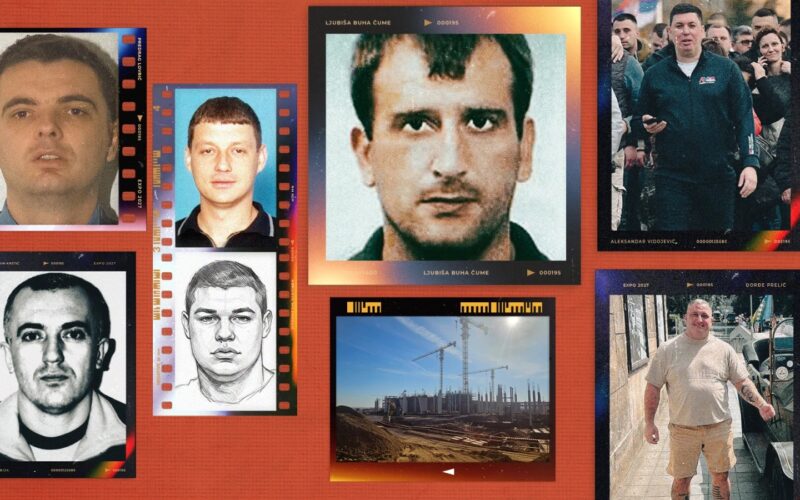
The Center for Investigative Journalism (CINS) reveals that the companies of associates and families of the former leader of the Surčin and member of the Zemun Clan, a convicted member of the Pink Panther group, and a person convicted of helping to cover up for for Željko Ražnatović – Arkan’s killer were engaged in work for the EXPO 2027. Aleksandar Vidojević’s sister – Ace Rošava, a close son of the President of Serbia and a Partizan fan, as well as the former leader of the Alcatraz group, convicted for the murder of Brice Taton. A businessman who serves as the vice president of the board of directors of FC Red Star, known for multi-million vehicle procurements for the Ministry of Interior (MUP), is also working on project.
CINS’s investigation has uncovered more than 200 companies – including those unknown to the public, backed by associates and relatives of people from criminal circles, as well as individuals close to the authorities.
Since mid-2023, when Serbia was officially selected to host the specialized international exhibition EXPO 2027, a trade and residential complex, a national football stadium, and supporting infrastructure have been springing up on the outskirts of Belgrade. While construction is progressing rapidly, the individuals involved in this state project have remained largely unnoticed.
For months, CINS tried to obtain an official list of companies involved in this project, but without success. For this reason, CINS investigated and uncovered the names of the companies through conversations with people, by contacting companies directly, and by collecting court and other documents. We’ve built a database of over 200 companies that we have confirmed are working on one of the most important state projects as contractors, subcontractors, or suppliers. These include companies whose involvement in the EXPO project was previously unknown to the public and that have ties to associates and relatives of people from criminal circles, as well as people close to the government.
The company Makiš Beton was founded in mid-2024 as a concrete production company. This was one year after Serbia was selected to host EXPO 2027. Financial reports indicate that this company was quickly hired for major state projects in the capital, such as Belgrade Waterfront and this project. Last year, Makiš Beton’s revenues increased sevenfold compared to 2024. Out of 2.1 billion dinar in income, 70% of the money came from working on EXPO 2027. The majority owner of the company is Marijana Đerić Mandreš, who CINS can reveal is the sister of Aleksandar Vidojević – a member of the former Partizan ultras group Janjičari, known for causing incidents, and a man close to the Serbian Progressive Party (SNS).
On Đerić Mandreš’s Facebook profile, there is no publicly available information regarding EXPO 2027. The profile only mentions her long-standing employment at Telekom Srbija. Aside from their fierce support for Partizan, she and her brother Aleksandar Vidojević are linked by their parents and the same address, as well as intertwined family and business relationships. In fact, Vidojević is registered at the same address as his sister and her husband – an apartment belonging to her husband’s father. The police looked for Vidojević at that address in February of this year because he was evading court. As they did not find him in the apartment, they called his sister, who told them that her brother informed her he had contacted the court and was currently abroad. Additionally, in May 2025, Vidojević’s wife, Nada, took over ownership of the company Ozon Clean, which until that point had been held by Nenad Mandreš, the husband of his sister Marijana.
Proceedings are currently underway against Vidojević for violent behavior, the First Basic Public Prosecutor’s Office in Belgrade confirmed for CINS. In fact, he ended up in custody following an incident at the nightclub Komitet in Beton Hala in 2018 and was later accused, along with ten others, of vandalizing the premises and beating several people. The trial has been postponed multiple times, and according to Radar, Vidojević did not appear at the hearings. Two traffic offense proceedings were also conducted against him at the Misdemeanor Court in Belgrade, but the statute of limitations has expired in both cases. For years, Vidojević has been linked to SNS. He led SNS activists and sympathizers who attended a pre-election convention at the Belgrade Arena. Also well-known are photos of Vidojević with Danilo Vučić – in the stands at the 2018 World Cup in Russia, and later at a Belgrade café, where they watched a match together.
In the court proceedings where he is accused of the torture and murder of seven people in Ritopek, drug trafficking, and possessing an arsenal of weapons, Veljko Belivuk named Aleksandar Vidojević as a key link to top state officials. The second co-owner of the company Makiš Beton, with a 40% share, is Vujadin Krstić, through his company Mačva Novogradnja. Krstić is linked to the murder case of Željko Ražnatović – Arkan at the Intercontinental Hotel in early 2000.
In fact, after being wounded in the shooting himself, Arkan’s killer Dobrosav Gavrić asked Krstić to find him a doctor in a private clinic in Loznica for medical help. The next day, Krstić took a bloody bulletproof vest from that clinic and brought it to his best man, Mile Đurić, instructing him to wash the vest, hide it, and lie if necessary that it had been brought from Kosovo. For aiding the killer, Krstić was sentenced to 4 years and 6 months in prison. Krstić is a metal milling machine operator by profession, and the verdict also noted that he was a reserve police officer in the early 2000s. Today, in addition to producing concrete, Vujadin Krstić runs a café-pizzeria in Loznica. CINS contacted both owners of Makiš Beton, Vujadin Krstić and Marijana Đerić Mandreš, who said in a brief conversation that they would call back later. When our journalist called them again, she was unable to establish contact with them.
According to documents reviewed by CINS, Valjevo Road Company (PZP Valjevo) provides sand for the road infrastructure project within EXPO. This company specializes in the construction, reconstruction, and maintenance of road infrastructure, and has been working for years on state projects like road and bridge construction and landslide remediation. For years, the former leader of the Surčin clan, Ljubiša Buha, aka Čume, has been associated with PZP Valjevo. In fact, this company was privatized in 2005 by Dušan Vasović, known to the public as Buha’s lawyer. Roughly 74% of the ownership in PZP Valjevo officially belongs to the lawyer Vasović, while the rest belongs to minority shareholders.
Buha’s ex-wife Ivana Tulović told that Buha is the real owner of numerous companies formally registered to other individuals – including PZP Valjevo and the Banja Luka-based firm Lein. CINS previously reported that Lein, together with its business partners, held the land and construction permits for small hydropower plants at 24 locations in the Bosilegrad municipality. Through co-ownership in the firm Pure Energy, it also participated in selling the Virovci small hydropower plant project to the company VS Energy, whose owners were Slavko Pandrc and his son Miloš Pandrc, a former member of Darko Šarić’s clan. Ljubiša Buha Čume was the leader of the Surčin clan, which in the 1990s was one of the most organized international cocaine and heroin smuggling rings in this part of Europe, according to MUP’s White Book – a document outlining organized crime groups from the early 2000s.
The group initially engaged in car theft and returning stolen vehicles for ransom before later turning to large-scale drug trafficking. It also amassed serious material wealth through the illegal trade of oil, petroleum products, and cigarettes. Ljubiša Buha – Čume was a cooperating witness in the trial for the assassination of Prime Minister Zoran Đinđić. The court evaluated Buha’s testimony as crucial to uncovering the inner workings of the Zemun Clan. Before the Prime Minister’s assassination, members of the Zemun Clan tried to kill Buha on multiple occasions, and by her own admission, his then-wife participated in one of the attempts.
The company NM Kop has been engaged in sand excavation for ten years. Since its founding in 2016, the owner of NM Kop has been Nemanja Milenković – son of Dejan Milenković Bagzi, a former member of the Zemun and Surčin clans. In a conversation with CINS, Nemanja Milenković initially denied his company’s involvement in the EXPO project, emphasizing that he does not carry out construction work. However, CINS obtained documents from the Third Basic Public Prosecutor’s Office regarding a criminal complaint against NM Kop over suspicions of illegal sand excavation. In the complaint, which was dismissed last year, excerpts from Milenković’s testimony are cited, where he states that at the time of the disputed excavation, in early 2025, NM Kop’s full capacities were engaged in the EXPO 2027 project.
After CINS’s journalist presented Milenković with the statement he gave to the prosecution, he admitted that the company had indeed participated in the project. “That was already finished last year.” Milenković ultimately specified that his role is strictly in the production and sale of sand. He claims that because of this, he does not have precise insight into where the material is later used, stating that he does not question drivers about where they take the sand after purchase.
Cases have been formed against Nemanja Milenković in several Belgrade prosecutor’s offices for multiple criminal offenses, which those offices confirmed to CINS. Among them is a charge for unauthorized possession of narcotics, of which he was later acquitted, and two complaints for theft were also dismissed. A pre-investigation proceeding for tax evasion is currently underway, while for the illegal possession of weapons, CINS was not provided with information regarding the outcome of the case.
The Misdemeanor Court in Belgrade conducted a total of 16 proceedings against Milenković and his company, including those for disturbing public order and peace, speeding, and improper overtaking. Only one ended in a conviction, and one in an acquittal. The statute of limitations expired in the others, or they are still ongoing, or the fine for which proceedings were initiated was paid. Nemanja Milenković’s father, Dejan Milenković Bagzi, was one of the key figures of the Surčin clan and later the Zemun Clan, who received the status of a cooperating witness in the trial for the assassination of Prime Minister Zoran Đinđić.
Prior to the assassination, he participated in an attempt on Đinđić’s life on the highway near today’s Belgrade Arena. The attack’s objective, as outlined in the plan, was to halt the vehicle and facilitate the assault. Bagzi was arrested immediately but was released shortly after. Following the assassination of Prime Minister Zoran Đinđić in March 2003 and the launch of police Operation Sablja (Saber), which targeted the perpetrators of the assassination, Milenković went on the run, successfully evading the largest police manhunt in the country. He was located and arrested in July 2004 in Greece, from where he was extradited to Serbia in February 2005.
A complaint was filed against NM Kop over suspicions that it illegally excavated sand last year – at the time it was engaged on EXPO 2027. In fact, a mining inspection carried out a special inspection of NM Kop in February and March 2025 and found an artificial lake on the ground where they were excavating sand. The inspection concluded that the company had gone beyond the boundaries for which it held a permit.
The topsoil was stripped by about three meters at locations for which the Ministry of Mining and Energy had not issued approval at the time, the inspection’s report states. The inspection banned the company from further sand excavation on the disputed plot and ordered it to restore the terrain to its previous state. Then, in May 2025, it filed a commercial offense complaint against NM Kop. These proceedings are still ongoing. Nemanja Milenković tells CINS that he was reported to the inspection by “people who do not exist, dead people,” and that he suspects the competing company, PZP Valjevo, is behind it all.
C&LC Kameni Agregati was founded in 2020 as a company for stone exploitation and processing. C&LC currently manages the Kamalj quarry near Mionica, where it extracts stone that is used, among other things, for the construction of the National Pavilion at the EXPO 2027 complex. The owner of C&LC Kameni Agregati since it was established has been Predrag Lovrić. Lovrić was previously on an Interpol warrant issued by the police from Vaduz in Liechtenstein.
Towards the end of 2022, a court in this town sentenced Lovrić to three years in prison, two of which were suspended, for a theft he participated in as a member of the Pink Panther Group in 2004. The Pink Panther Group is a group specialized in robbing jewelry stores around the world. The Kamalj quarry, where Lovrić’s company operates, is located in an area where stone excavation was previously prohibited. CINS previously reported that following an initiative by the Municipality of Mionica, the study on the sanitary protection zones of the Paštrić water source was amended, thus removing Kamalj from the zone where stone exploitation was not permitted. The company excavated stone before it obtained all the necessary permits, and because of this, it paid about 11.5 million RSD in fees for the mineral raw materials excavated in 2021.
In June 2025, an entrepreneurial business named CAP 1 ALCZ was established. Its owner is Đorđe Prelić, one of the leaders of the former Partizan ultras group Alcatraz, who was convicted of the murder of French fan Brice Taton. Prelić was convicted of illegal possession and trafficking of weapons and inflicting grievous bodily harm, while the proceedings against him for attacking an official were suspended.
As a reminder, Prelić was convicted for participating in the murder of Brice Taton, a fan of the French football club Toulouse. According to the verdict, in the center of Belgrade, Partizan ultras attacked fans from France, including Taton, whom they brutally beat and then threw headfirst over a staircase railing. He died from his injuries in a Belgrade hospital. Prelić was initially sentenced to 35 years in prison, which was ultimately reduced to 10 years. After serving two-thirds of his sentence, he was released from prison.
The Čačak-based company Betonjerka, whose primary business is the manufacture of concrete products for construction, is engaged in the landscape architecture and horticulture project within the construction of the EXPO 2027 complex. Behind this company, through a series of other enterprises that appear in a complex ownership structure, are Milenko Kostić and Slobodan Čakarević. There is not much information about Čakarević in public, while Kostić has been publicly prominent for decades as the vice president of the Board of Directors of Red Star Football Club and the owner of the company Auto Čačak.
In fact, since 1996, Kostić’s company has been the general importer of Czech Škoda vehicles for Serbia. Kostić himself stated in an interview with Vesti Zapadne Srbije that political connections helped his business, admitting that he joined the Yugoslav Left (JUL) in 1997 to secure vehicle import contingents. The connection with political structures and securing state contracts continued in the decades that followed.
For years, the company Auto Čačak has been procuring cars for state institutions. In 2019 alone, the Ministry of Interior (MUP) procured vehicles worth nearly 954 million RSD from this company, according to Nova.rs. Previously, it was also reported that in 2017, the police bought over 700 Škodas from Auto Čačak, a deal that was declared secret. The current mayor of Čačak and high-ranking official of the SNS, Milun Todorović, worked for years before entering public office as the director of sales and marketing, and subsequently as the general manager of Kostić’s company Auto Čačak.
Discover more from The Balkan Report
Subscribe to get the latest posts sent to your email.