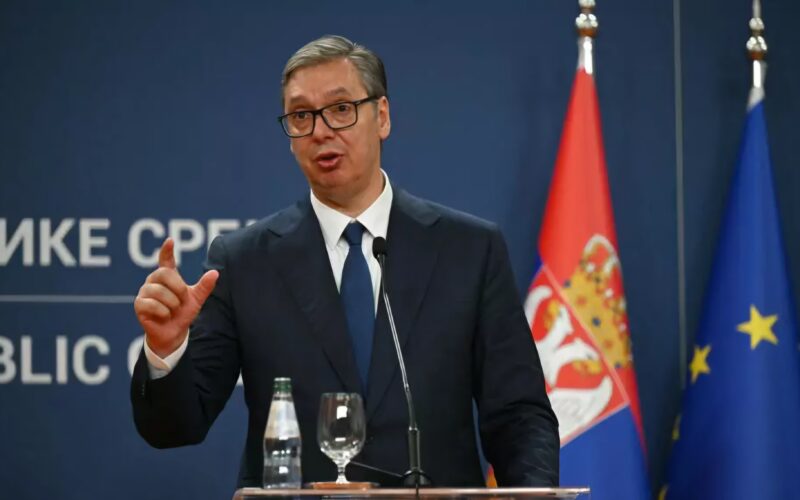
For more than a decade, Aleksandar Vučić has built one of the most powerful political machines in modern Europe. He has combined control over state institutions, overwhelming access to national media, nationalist rhetoric, and a foreign policy that balances between Brussels, Moscow, and Beijing. The October 25 parliamentary election now represents the most serious test of that system in years.
The key question is not simply whether Vučić will win, it is whether Serbian voters will be given a genuinely competitive choice. In modern hybrid regimes, electoral manipulation rarely depends on the crude falsification of ballot papers; it is often achieved before election day through control of the media, political narratives, and the conditions under which opponents campaign.
Serbia already shows many of these characteristics. The OSCE has deployed an election observation mission for October 25, while Serbian monitoring organization CRTA has documented severe inequalities between political actors, political pressure, and an overwhelming advantage for the ruling establishment in television coverage. Ninety-six percent of political airtime on the public broadcaster’s flagship “Dnevnik 2” was devoted to the ruling majority, with Vučić himself accounting for half of that coverage.
The significance is obvious: an election can be formally competitive while being structurally unequal. When the government has vastly greater access to television coverage, administrative resources, and institutional visibility, the contest is distorted long before voters enter polling stations. Vučić has perfected this model. Freedom House’s 2026 assessment points to continuing pressure on media freedom, political influence over the information environment, intimidation of independent journalists, and smear campaigns against political opponents.
The decision to hold parliamentary elections now is itself politically significant. The vote was expected in 2027, but Vučić brought it forward after months of student protests, apparently seeking to regain the initiative before the protest movement could transform its street mobilization into an effective electoral organization. The students represent a different kind of threat from Serbia’s traditional opposition. Their movement emerged after the November 2024 collapse of the railway station canopy in Novi Sad, which killed 16 people, and evolved into a wider challenge to corruption, political impunity, and institutional failure.
The government’s response has increasingly relied on portraying domestic opponents as instruments of foreign interests. This tactic shifts attention away from corruption and institutional accountability and toward sovereignty and national security, it also fits naturally into Vučić’s broader geopolitical strategy.
Vučić has deliberately balanced Serbia between Brussels, Moscow, and Beijing, using each relationship to expand his political room for maneuver. Serbia remains formally committed to EU membership but has refused to align fully with Western sanctions against Russia. Moscow provides energy, diplomatic backing, and a powerful nationalist narrative, particularly over Kosova. China, meanwhile, has become a major economic and strategic partner through infrastructure, investment, and technology, offering Belgrade an alternative source of capital and political support without demanding the democratic reforms associated with EU membership. For years, European governments have treated Vučić as a difficult but indispensable partner.
The international press has described Vučić as a potential “Trojan Horse” for Vladimir Putin in Europe and argued that he is preparing to manipulate the October election. There is substantial evidence that the ruling establishment enjoys structural advantages capable of compromising the fairness of the contest. CRTA has also raised concerns about organizations appearing under names similar to those associated with the student electoral movement, potentially creating voter confusion. In a heavily polarized media environment, confusion itself can become an electoral weapon.
Vučić’s recent political maneuvering reinforces the picture of a system centered on one individual. His resignation as president on September 27 did not represent a withdrawal from politics. Having reached the constitutional limit on presidential terms, he is seeking the premiership in an effort to maintain his personal control over the political system. This concentration of power is precisely what the student movement has challenged. If the ruling establishment dominates public broadcasting, exploits state resources, intimidates critics, confuses voters, and systematically restricts meaningful competition, a formal victory cannot by itself establish democratic legitimacy.
The EU can continue prioritizing short-term stability and geopolitical convenience, effectively accepting an increasingly managed political system, or it can insist that democratic standards are fundamental to Serbia’s European future. The second choice carries risks. Serbia could respond to Western pressure by moving closer to Moscow and Beijing, but tolerating democratic deterioration carries a greater long-term danger: the consolidation of an authoritarian model in the center of the Western Balkans. The West must therefore reject the false choice between Vučić and chaos.
The European Union cannot credibly demand rule-of-law reforms from Serbia while rewarding the political architecture that prevents those reforms from taking root. Washington, D.C. cannot describe Serbia as strategically important while treating democratic deterioration as an inconvenient secondary issue. And the Balkans cannot afford another model in which elections become rituals for renewing power rather than mechanisms for transferring it.
Vučić’s greatest political advantage has always been his ability to present himself as indispensable. His greatest vulnerability is the emergence of citizens who no longer accept that premise. The student movement has challenged not simply a government but the political assumption that Serbia must be governed by the same structure indefinitely. That is why the October election matters far beyond the composition of the next parliament.
The choice before Serbia is ultimately straightforward: it is between institutions that constrain power and a political system in which power increasingly controls the institutions. The difference will not be determined by speeches in Brussels, Moscow, or Washington, D.C. It will be determined by whether Serbian citizens can vote without intimidation, access competing information, organize freely, and trust that their votes will be counted.
The international community should make one point unmistakably clear: Serbia’s sovereignty does not belong to Aleksandar Vučić. No government, however powerful, has the right to convert that sovereignty into permanent political ownership.
If October 25 shows that Serbian voters can still remove a government through a genuinely free and competitive election, Serbia’s democracy will have survived its greatest test in years. If it does not, Europe should stop calling the outcome “stability” and instead call it what it is: an authoritarian system using elections not to give power to the people but to give the appearance of legitimacy to those who already hold it. /The Balkan Report/
Discover more from The Balkan Report
Subscribe to get the latest posts sent to your email.