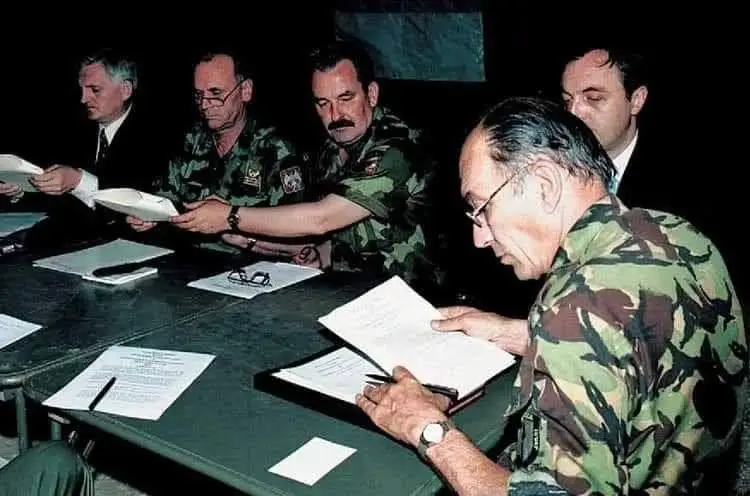
June 9, 1999, marked one of the most decisive moments in the modern history of the Balkans. On that day, following 78 days of North Atlantic Treaty Organization air strikes against military, police, and strategic targets of the former Yugoslavia, Serbian military representatives signed the Kumanova Agreement, the document that brought the Kosova War to an end and paved the way for the deployment of international security forces throughout Kosova. For many scholars, historians, and experts in international relations, this agreement was far more than a ceasefire or a technical military document. It represented the capitulation of Slobodan Milošević’s aggressive policies and Serbia’s acknowledgment of defeat in its attempt to maintain control over Kosova through force.
For Albanians, June 9 represents the end of a period of repression, violence, and ethnic cleansing that reached its peak during the 1990s. It marks the moment when the regime in Belgrade was compelled to withdraw its army, police, and paramilitary structures from Kosova, bringing to an end a policy aimed at altering the territory’s ethnic composition and subjugating its Albanian-majority population.
To fully understand the significance of the Kumanova Agreement, it is necessary to revisit the events that preceded it. Throughout 1998 and 1999, Kosova became the center of a brutal conflict in which Milošević’s regime carried out a systematic campaign of repression against the ethnic Albanians. Serbian military and police operations were accompanied by mass killings, forced expulsions, the destruction of villages and towns, and grave violations of human rights. Reports by international organizations, monitoring missions, and human rights groups documented a clear pattern of ethnic cleansing designed to reshape Kosova’s demographic structure and drive Albanians from their homeland.
The massacres carried out in Reçak, Izbicë, Meja, Krusha e Madhe, Poklek, and dozens of other locations were not isolated incidents. They formed part of a broader strategy of state terror aimed at intimidating, expelling, and subjugating the Albanian civilian population. During the war, more than 800,000 ethnic Albanians were forcibly expelled from Kosova, while thousands of others were killed or disappeared. Images of columns of refugees crossing into Albania and North Macedonia became symbols of the humanitarian catastrophe unfolding in the heart of Europe.
The policies of Milošević’s regime did not emerge in an ideological vacuum, they were rooted in a nationalist narrative developed over decades that portrayed Kosova as the historical and spiritual heartland of the Serbian nation. Elements within the hierarchy of the Serbian Orthodox Church played a significant role in promoting this narrative. Throughout the 1980s and 1990s, prominent church figures publicly supported Serbian nationalist discourse. Clergy members and influential religious leaders frequently legitimized Belgrade’s political claims over Kosova and contributed to the creation of a climate in which repression against Albanians was presented as a defense of Serbian national and religious interests.
Although the Serbian Orthodox Church was not formally part of the military and police structures that committed crimes in Kosova, its proximity to the Serbian nationalist project of that era has been widely documented by scholars of Balkan history. In many cases, the rhetoric of certain church figures contributed to the moral and ideological legitimization of policies that led to repression, expulsions, and crimes against the Albanian population. This alliance between political nationalism and religious legitimization constituted one of the ideological pillars of Milošević’s project.
Yet, in the face of this machinery of state repression, organized Albanian resistance emerged. The Kosova Liberation Army (UÇK) became the principal force confronting the Serbian army, police, and paramilitary formations. After years of systematic discrimination, institutional exclusion, and state violence against Kosova Albanians, the UÇK evolved into a symbol of resistance and the struggle for freedom.
Despite Serbia’s overwhelming military superiority, the UÇK succeeded in establishing areas of resistance across Kosova and keeping Serbian forces engaged on the ground. Its fighters endured successive military and police offensives, sustaining resistance at a time when the Serbian state apparatus possessed vastly superior military and logistical resources.
The UÇK’s role extended beyond the military sphere. Its activities directly contributed to the internationalization of the Kosova issue. The fighting on the ground, the brutal response of Serbian forces, and the escalation of the crisis made it impossible for the international community to continue treating Kosova as merely an internal Serbian matter. In this sense, the UÇK’s resistance helped create the political and diplomatic conditions that eventually led to the involvement of Western powers and, ultimately, NATO’s military intervention.
By the spring of 1999, the international community had concluded that the Kosova crisis could no longer be resolved through diplomatic means. The Rambouillet Conference had failed, despite the Albanian delegation’s acceptance of the proposed agreement, largely because of Belgrade’s refusal to accept a settlement that would guarantee peace and security in Kosova. Meanwhile, Serbian forces continued their military operations on the ground. Faced with this situation, NATO decided to intervene militarily on March 24, 1999, launching an air campaign that would last for 78 days.
NATO’s intervention represented a historic moment not only for Kosova but also for the Alliance itself. It was the first time NATO had undertaken such a military operation without a direct mandate from the United Nations Security Council, arguing that there was a moral and political obligation to prevent a humanitarian catastrophe in the heart of Europe. In practical terms, the intervention altered the course of events in Kosova and halted a campaign of repression that had reached alarming proportions.
During the 78 days of bombing, Yugoslavia’s military infrastructure sustained significant damage. Military bases, air-defense systems, command centers, weapons depots, bridges, and other strategic facilities that supported Serbian operations in Kosova were targeted. Although Milošević’s regime attempted to project an image of resilience and defiance, the reality on the ground was becoming increasingly unsustainable. International isolation, economic devastation, military losses, and diplomatic pressure created conditions under which continuing the war was no longer viable.
At the same time, the UÇK continued its resistance against Serbian forces on the ground. This created pressure on Belgrade from two fronts: from the air through NATO’s campaign and from the ground through the actions of the UÇK. Many historians and military experts regard the combination of these two factors as the decisive element that ultimately compelled Milošević’s regime to accept defeat.
It was in this context that the negotiations leading to the Kumanova Agreement took place. The document was signed between NATO representatives and the Yugoslav military command in the town of Kumanova. The essence of the agreement was clear: Serbian military, police, and paramilitary forces were required to withdraw completely from Kosova, while NATO-led peacekeeping forces, known as KFOR, would be deployed throughout the territory.
Although the UÇK was not a formal signatory to the Kumanova Agreement, its contribution to the circumstances that made the agreement possible was undeniable. Its years of resistance, the sacrifices of thousands of fighters, and the broad support it enjoyed among Kosova Albanians made any return to the previous status quo impossible. In many respects, the agreement also represented a de-facto acknowledgment of Serbia’s failure to defeat Albanian resistance.
These elements are precisely what lead many observers to characterize the Kumanova Agreement as an act of military capitulation. Serbia was not only forced to cease its operations in Kosova; it also lost effective control over the territory. In international relations and military studies, effective territorial control is one of the fundamental elements of state sovereignty. From the moment Serbian forces withdrew and security administration passed to international forces, Belgrade ceased to exercise real authority on the ground.
For this reason, many analysts regard the Kumanova Agreement as the capitulation of Milošević’s regime in Kosova. Although the term capitulation is often used cautiously in diplomatic discourse, the substance of the agreement reflected a reality that many consider undeniable: Serbia accepted conditions imposed by NATO after a military campaign that it was unable to stop. This was not a compromise between equal parties but rather the acceptance of terms dictated by the victorious side.
For Kosova, June 9 marked the beginning of a new historical era. Following the withdrawal of Serbian forces, hundreds of thousands of forcibly displaced Albanians began returning to their homes. Within weeks, most refugees who had found shelter in Albania, North Macedonia, and elsewhere returned to Kosova. This mass return represented not only a humanitarian victory but also the ultimate failure of the ethnic-cleansing project pursued by the Serbian regime.
Politically, the Kumanova Agreement and United Nations Security Council Resolution 1244 created the framework for Kosova’s international administration. Although Kosova’s final status remained unresolved for several years, the process that began in June 1999 would gradually lead to Kosova’s declaration of independence on February 17, 2008. In this sense, the Kumanova Agreement can be seen as the turning point that made the emergence of the Kosovan state possible.
From Serbia’s perspective, the loss of Kosova represented a major strategic and political setback. Milošević had built his legitimacy on nationalism, territorial control, and the mythology of Kosova as the heart of Serbian national identity. Losing effective control over the territory not only weakened his international position but also contributed directly to the collapse of his regime. Just one year later, in October 2000, Milošević was overthrown following mass protests in Serbia.
He was subsequently extradited to the International Criminal Tribunal for the former Yugoslavia in The Hague, where he faced charges of war crimes, crimes against humanity, and serious violations of international humanitarian law. Although the trial remained unfinished because of his death in 2006, Milošević’s political legacy remains inseparable from the destructive wars that accompanied the breakup of Yugoslavia.
Twenty-seven years after the Kumanova Agreement, its significance continues to resonate in political and historical debates. For Kosova, it represents the end of Serbian rule and the beginning of the path toward statehood. For NATO, it remains one of the most important operations in the Alliance’s history and a notable example of the use of military force to stop mass atrocities against civilians. For Serbia, it remains a reminder of a defeat that continues to influence domestic politics and relations with Kosova.
In the collective memory of Kosova Albanians, the victory of June 1999 is closely associated with two parallel forces: the resistance of the Kosova Liberation Army and NATO’s military intervention. Neither can be fully understood without the other. The UÇK kept resistance alive, challenged Serbian control on the ground, and transformed Kosova into an international issue, while NATO created the military balance that forced Belgrade to accept defeat. The Kumanova Agreement was the point at which these two processes converged and brought Serbian rule in Kosova to an end.
Ultimately, the Kumanova Agreement was not simply the end of a war. It marked the end of a political project that sought to subjugate Kosova through force, state violence, and ethnic cleansing. It was the moment when NATO’s military power, the resistance of the people of Kosova through the UÇK, and international pressure combined to impose a new political reality in the Balkans. For this reason, June 9 remains a date that symbolizes not only the end of the war but also the triumph of freedom over repression and justice over force, affirming the right of a people to live freely in their homeland. /The Balkan Report/
Discover more from The Balkan Report
Subscribe to get the latest posts sent to your email.